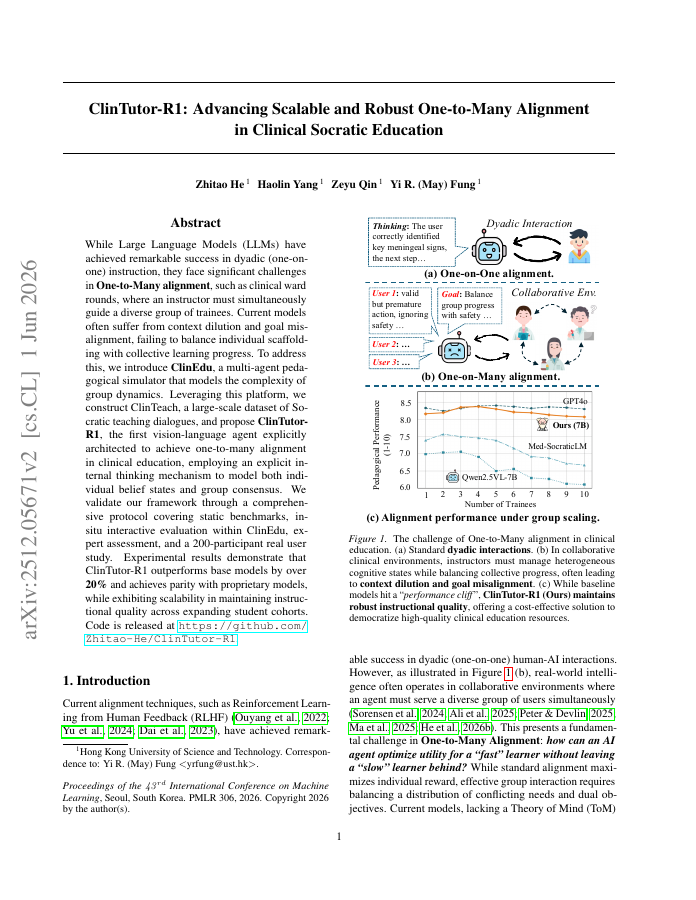
While Large Language Models (LLMs) have achieved remarkable success in dyadic (one-on-one) instruction, they face significant challenges in One-to-Many alignment, such as clinical ward rounds, where an instructor must simultaneously guide a diverse group of trainees. Current models often suffer from context dilution and goal misalignment, failing to balance individual scaffolding with collective learning progress. To address this, we introduce ClinEdu, a multi-agent pedagogical simulator that models the complexity of group dynamics. Leveraging this platform, we construct ClinTeach, a large-scale dataset of Socratic teaching dialogues, and propose ClinTutor-R1, the first vision-language agent explicitly architected to achieve one-to-many alignment in clinical education, employing an explicit internal thinking mechanism to model both individual belief states and group consensus. We validate our framework through a comprehensive protocol covering static benchmarks, in-situ interactive evaluation within ClinEdu, expert assessment, and a 200-participant real user study. Experimental results demonstrate that ClinTutor-R1 outperforms base models by over 20% and achieves parity with proprietary models, while exhibiting scalability in maintaining instructional quality across expanding student cohorts.
ClinTutor-R1: Advancing Scalable and Robust One-to-Many Alignment in Clinical Socratic Education
While Large Language Models (LLMs) have achieved remarkable success in dyadic (one-on-one) instruction, they face significant challenges in One-to-Many alignment, such as clinical ward rounds, where an instructor must simultaneously guide a diverse group of trainees.
- Preview
- Year
- 2025
- Hosting
- Full text hostedCC-BY-4.0
Cite
Notes
Only stored in your browser.
Attribution
- Abstract & full text
- arxiv.org/abs/2512.05671CC-BY-4.0
- TL;DR
- Semantic Scholar