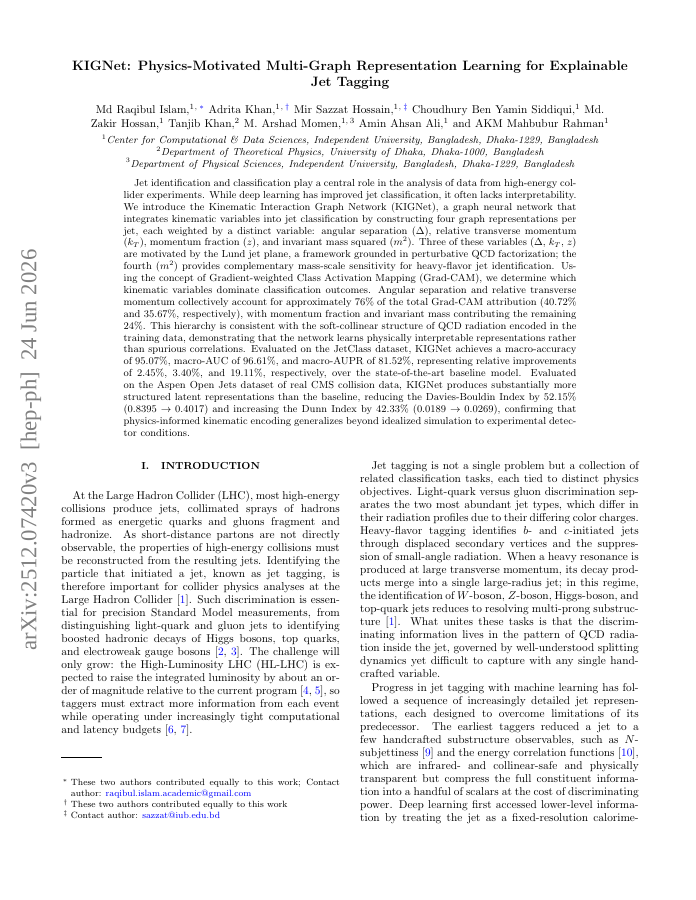
Jet identification plays a central role in analyzing data from high-energy collider experiments. While deep learning has improved jet classification, it often lacks interpretability. We introduce the Kinematic Interaction Graph Network (KIGNet), a graph neural network that integrates kinematic variables into jet classification by constructing four graph representations per jet, each weighted by a distinct variable: angular separation (Δ), relative transverse momentum (k_T), momentum fraction (z), and invariant mass squared (m^2). Three of these (Δ, k_T, z) are motivated by the Lund jet plane, grounded in perturbative QCD factorization; the fourth (m^2) adds complementary mass-scale sensitivity for heavy-flavor identification. Using Gradient-weighted Class Activation Mapping (Grad-CAM), we determine which variables dominate classification. Angular separation and relative transverse momentum account for about 76% of the total Grad-CAM attribution (40.72% and 35.67%), with momentum fraction and invariant mass contributing the remaining 24%. This hierarchy is consistent with the soft-collinear structure of QCD radiation in the training data, showing that the network learns physically interpretable representations rather than spurious correlations. On the JetClass dataset, KIGNet achieves a macro-accuracy of 95.07%, macro-AUC of 96.61%, and macro-AUPR of 81.52%, relative improvements of 2.45%, 3.40%, and 19.11% over the state-of-the-art baseline. On the Aspen Open Jets dataset of real CMS collision data, KIGNet produces substantially more structured latent representations than the baseline, reducing the Davies-Bouldin Index by 52.15% (0.8395 \rightarrow 0.4017) and increasing the Dunn Index by 42.33% (0.0189 \rightarrow 0.0269), confirming that physics-informed kinematic encoding generalizes beyond idealized simulation to experimental detector conditions.
KIGNet: Physics-Motivated Multi-Graph Representation Learning for Explainable Jet Tagging
Jet identification plays a central role in analyzing data from high-energy collider experiments. While deep learning has improved jet classification, it often lacks interpretability.
- Preview
- Year
- 2025
- Hosting
- Full text hostedCC-BY-4.0
Cite
Notes
Only stored in your browser.
Attribution
- Abstract & full text
- arxiv.org/abs/2512.07420CC-BY-4.0
- TL;DR
- Semantic Scholar