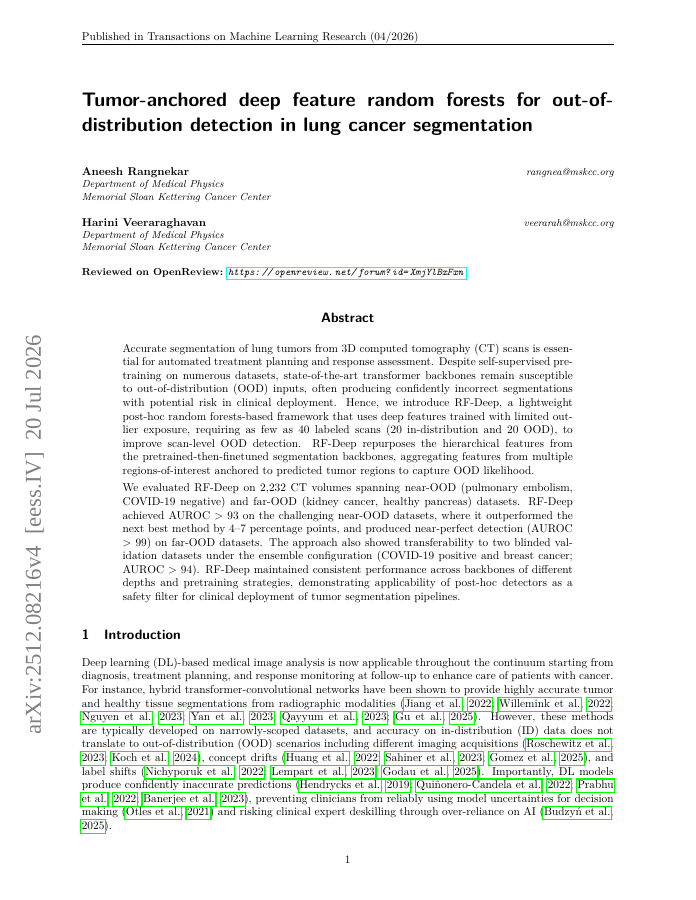
Accurate segmentation of lung tumors from 3D computed tomography (CT) scans is essential for automated treatment planning and response assessment. Despite self-supervised pretraining on numerous datasets, state-of-the-art transformer backbones remain susceptible to out-of-distribution (OOD) inputs, often producing confidently incorrect segmentations with potential for risk in clinical deployment. Hence, we introduce RF-Deep, a lightweight post-hoc random forests-based framework that leverages deep features trained with limited outlier exposure, requiring as few as 40 labeled scans (20 in-distribution and 20 OOD), to improve scan-level OOD detection. RF-Deep repurposes the hierarchical features from the pretrained-then-finetuned segmentation backbones, aggregating features from multiple regions-of-interest anchored to predicted tumor regions to capture OOD likelihood. We evaluated RF-Deep on 2,232 CT volumes spanning near-OOD (pulmonary embolism, COVID-19 negative) and far-OOD (kidney cancer, healthy pancreas) datasets. RF-Deep achieved AUROC > 93 on the challenging near-OOD datasets, where it outperformed the next best method by 4--7 percentage points, and produced near-perfect detection (AUROC > 99) on far-OOD datasets. The approach also showed transferability to two blinded validation datasets under the ensemble configuration (COVID-19 positive and breast cancer; AUROC > 94). RF-Deep maintained consistent performance across backbones of different depths and pretraining strategies, demonstrating applicability of post-hoc detectors as a safety filter for clinical deployment of tumor segmentation pipelines.
Tumor-anchored deep feature random forests for out-of-distribution detection in lung cancer segmentation
Accurate segmentation of lung tumors from 3D computed tomography (CT) scans is essential for automated treatment planning and response assessment. Despite self-supervised pretraining on numerous datasets, state-of-the-art transformer backbones remain susceptible to…
- Preview
- Year
- 2025
- Hosting
- Abstract onlyARXIV-DEFAULT
Cite
Notes
Only stored in your browser.
Attribution
- Abstract & full text
- arxiv.org/abs/2512.08216ARXIV-DEFAULT
- TL;DR
- Semantic Scholar