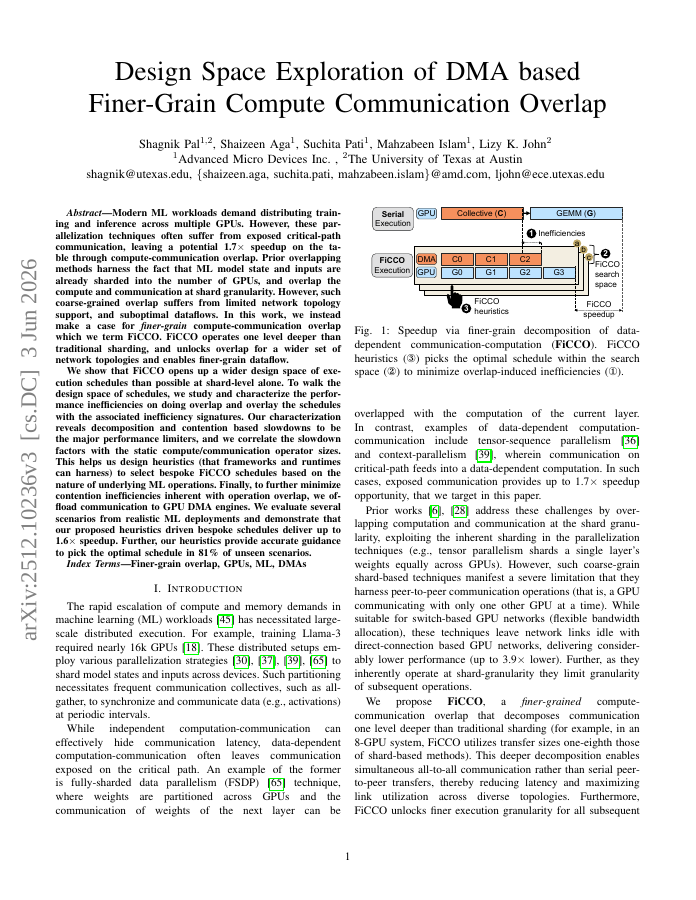
Modern ML workloads demand distributing training and inference across multiple GPUs. However, these parallelization techniques often suffer from exposed critical-path communication, leaving a potential 1.7x speedup on the table through compute-communication overlap. Prior overlapping methods harness the fact that ML model state and inputs are already sharded into the number of GPUs, and overlap the compute and communication at shard granularity. However, such coarse-grained overlap suffers from limited network topology support, and suboptimal dataflows. In this work, we instead make a case for finer-grain compute-communication overlap which we term FiCCO. FiCCO operates one level deeper than traditional sharding, and unlocks overlap for a wider set of network topologies and enables finer-grain dataflow. We show that FiCCO opens up a wider design space of execution schedules than possible at shard-level alone. To walk the design space of schedules, we study and characterize the performance inefficiencies on doing overlap and overlay the schedules with the associated inefficiency signatures. Our characterization reveals decomposition and contention based slowdowns to be the major performance limiters, and we correlate the slowdown factors with the static compute/communication operator sizes. This helps us design heuristics (that frameworks and runtimes can harness) to select bespoke FiCCO schedules based on the nature of underlying ML operations. Finally, to further minimize contention inefficiencies inherent with operation overlap, we offload communication to GPU DMA engines. We evaluate several scenarios from realistic ML deployments and demonstrate that our proposed heuristics driven bespoke schedules deliver up to 1.6x speedup. Further, our heuristics provide accurate guidance to pick the optimal schedule in 81% of unseen scenarios.
Design Space Exploration of DMA based Finer-Grain Compute Communication Overlap
Modern ML workloads demand distributing training and inference across multiple GPUs. However, these parallelization techniques often suffer from exposed critical-path communication, leaving a potential 1.7x speedup on the table through compute-communication overlap.
- Preview
- Year
- 2025
- Hosting
- Abstract onlyARXIV-DEFAULT
Cite
Notes
Only stored in your browser.
Attribution
- Abstract & full text
- arxiv.org/abs/2512.10236ARXIV-DEFAULT
- TL;DR
- Semantic Scholar