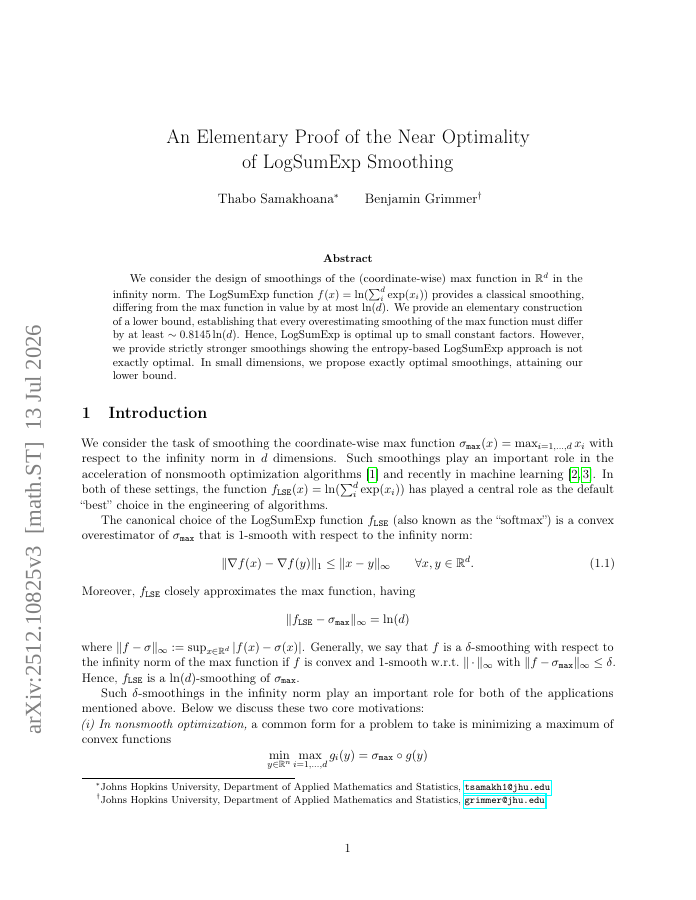
We consider the design of smoothings of the (coordinate-wise) max function in \mathbb{R}^d in the infinity norm. The LogSumExp function f(x)=\ln(\sum^d_i\exp(x_i)) provides a classical smoothing, differing from the max function in value by at most \ln(d). We provide an elementary construction of a lower bound, establishing that every overestimating smoothing of the max function must differ by at least \sim 0.8145\ln(d). Hence, LogSumExp is optimal up to small constant factors. However, we provide strictly stronger smoothings showing the entropy-based LogSumExp approach is not exactly optimal. In small dimensions, we propose exactly optimal smoothings, attaining our lower bound.
An Elementary Proof of the Near Optimality of LogSumExp Smoothing
We consider the design of smoothings of the (coordinate-wise) max function in $\mathbb{R}^d$ in the infinity norm. The LogSumExp function $f(x)=\ln(\sum^d_i\exp(x_i))$ provides a classical smoothing, differing from the max function in value by at most $\ln(d)$.
- Preview
- Year
- 2025
- Hosting
- Abstract onlyARXIV-DEFAULT
Cite
Notes
Only stored in your browser.
Attribution
- Abstract & full text
- arxiv.org/abs/2512.10825ARXIV-DEFAULT
- TL;DR
- Semantic Scholar