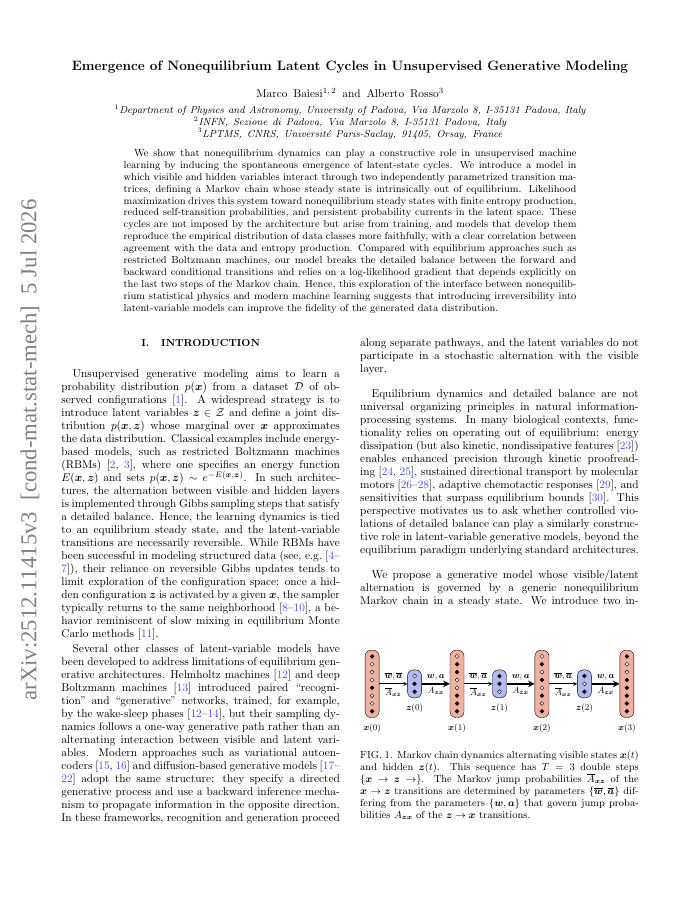
We show that nonequilibrium dynamics can play a constructive role in unsupervised machine learning by inducing the spontaneous emergence of latent-state cycles. We introduce a model in which visible and hidden variables interact through two independently parametrized transition matrices, defining a Markov chain whose steady state is intrinsically out of equilibrium. Likelihood maximization drives this system toward nonequilibrium steady states with finite entropy production, reduced self-transition probabilities, and persistent probability currents in the latent space. These cycles are not imposed by the architecture but arise from training, and models that develop them reproduce the empirical distribution of data classes more faithfully, with a clear correlation between agreement with the data and entropy production. Compared with equilibrium approaches such as restricted Boltzmann machines, our model breaks the detailed balance between the forward and backward conditional transitions and relies on a log-likelihood gradient that depends explicitly on the last two steps of the Markov chain. Hence, this exploration of the interface between nonequilibrium statistical physics and modern machine learning suggests that introducing irreversibility into latent-variable models can improve the fidelity of the generated data distribution.
Emergence of Nonequilibrium Latent Cycles in Unsupervised Generative Modeling
We show that nonequilibrium dynamics can play a constructive role in unsupervised machine learning by inducing the spontaneous emergence of latent-state cycles. We introduce a model in which visible and hidden variables interact through two independently parametrized transition…
- Preview
- Year
- 2025
- Hosting
- Abstract onlyARXIV-DEFAULT
Cite
Notes
Only stored in your browser.
Attribution
- Abstract & full text
- arxiv.org/abs/2512.11415ARXIV-DEFAULT
- TL;DR
- Semantic Scholar