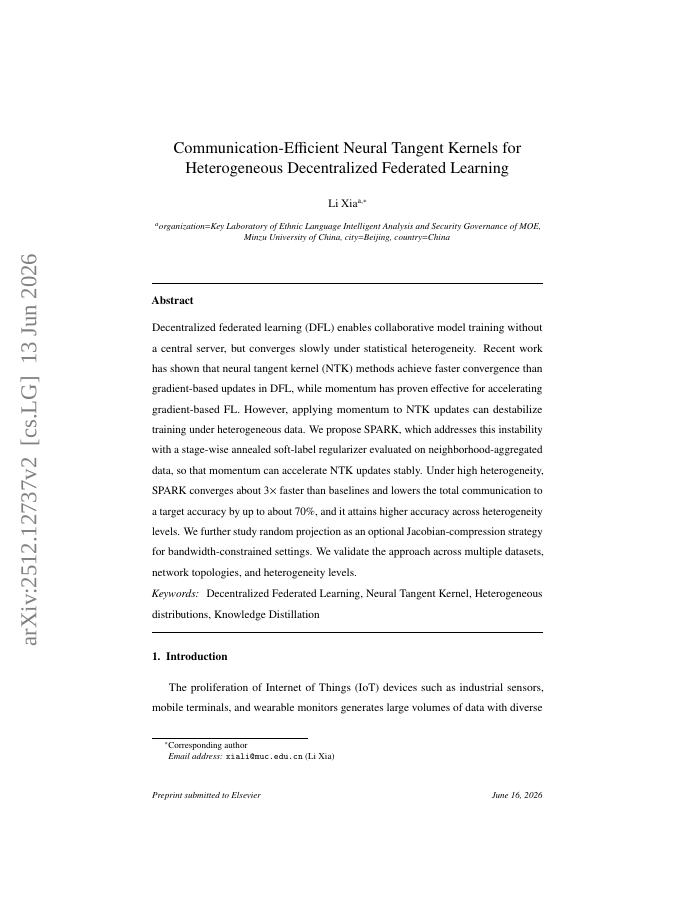
Decentralized federated learning (DFL) enables collaborative model training without a central server, but converges slowly under statistical heterogeneity. Recent work has shown that neural tangent kernel (NTK) methods achieve faster convergence than gradient-based updates in DFL, while momentum has proven effective for accelerating gradient-based FL. However, applying momentum to NTK updates can destabilize training under heterogeneous data. We propose SPARK, which addresses this instability with a stage-wise annealed soft-label regularizer evaluated on neighborhood-aggregated data, so that momentum can accelerate NTK updates stably. Under high heterogeneity, SPARK converges about 3\times faster than baselines and lowers the total communication to a target accuracy by up to about 70%, and it attains higher accuracy across heterogeneity levels. We further study random projection as an optional Jacobian-compression strategy for bandwidth-constrained settings. We validate the approach across multiple datasets, network topologies, and heterogeneity levels.
Communication-Efficient Neural Tangent Kernels for Heterogeneous Decentralized Federated Learning
Decentralized federated learning (DFL) enables collaborative model training without a central server, but converges slowly under statistical heterogeneity. Recent work has shown that neural tangent kernel (NTK) methods achieve faster convergence than gradient-based updates in…
- Preview
- Year
- 2025
- Hosting
- Excerpt onlyCC-BY-NC-4.0
Cite
Notes
Only stored in your browser.
Attribution
- Abstract & full text
- arxiv.org/abs/2512.12737CC-BY-NC-4.0
- TL;DR
- Semantic Scholar