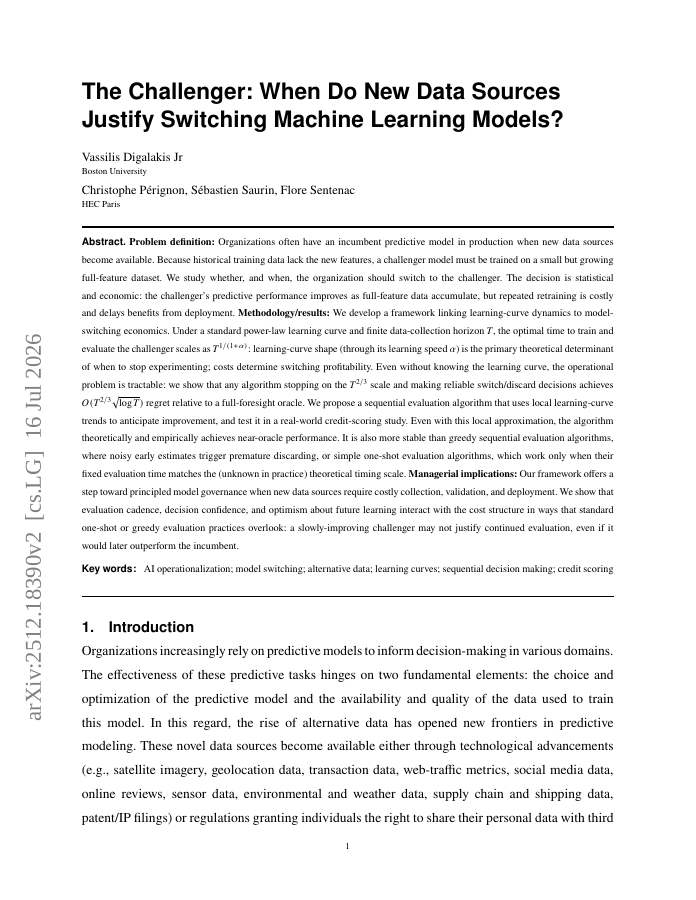
Organizations often have an incumbent predictive model in production when new data sources become available. Because historical training data lack the new features, a challenger model must be trained on a small but growing full-feature dataset. We study whether, and when, the organization should switch to the challenger. The decision is statistical and economic: the challenger's predictive performance improves as full-feature data accumulate, but repeated retraining is costly and delays benefits from deployment. We develop a framework linking learning-curve dynamics to model-switching economics. Under a standard power-law learning curve and finite data-collection horizon T, the optimal time to train and evaluate the challenger scales as T^{1/(1+α)}: learning-curve shape (through its learning speed α) is the primary theoretical determinant of when to stop experimenting; costs determine switching profitability. Even without knowing the learning curve, the operational problem is tractable: we show that any algorithm stopping on the T^{2/3} scale and making reliable switch/discard decisions achieves O(T^{2/3}\sqrt{\log T}) regret relative to a full-foresight oracle. We propose a sequential evaluation algorithm that uses local learning-curve trends to anticipate improvement, and test it in a real-world credit-scoring study. Even with this local approximation, the algorithm theoretically and empirically achieves near-oracle performance. It is also more stable than greedy sequential evaluation algorithms, where noisy early estimates trigger premature discarding, or simple one-shot evaluation algorithms, which work only when their fixed evaluation time matches the (unknown in practice) theoretical timing scale. Our framework offers a step toward principled model governance when new data sources require costly collection, validation, and deployment.
The Challenger: When Do New Data Sources Justify Switching Machine Learning Models?
Organizations often have an incumbent predictive model in production when new data sources become available. Because historical training data lack the new features, a challenger model must be trained on a small but growing full-feature dataset.
- Preview
- Year
- 2025
- Hosting
- Full text hostedCC-BY-4.0
Cite
Notes
Only stored in your browser.
Attribution
- Abstract & full text
- arxiv.org/abs/2512.18390CC-BY-4.0
- TL;DR
- Semantic Scholar