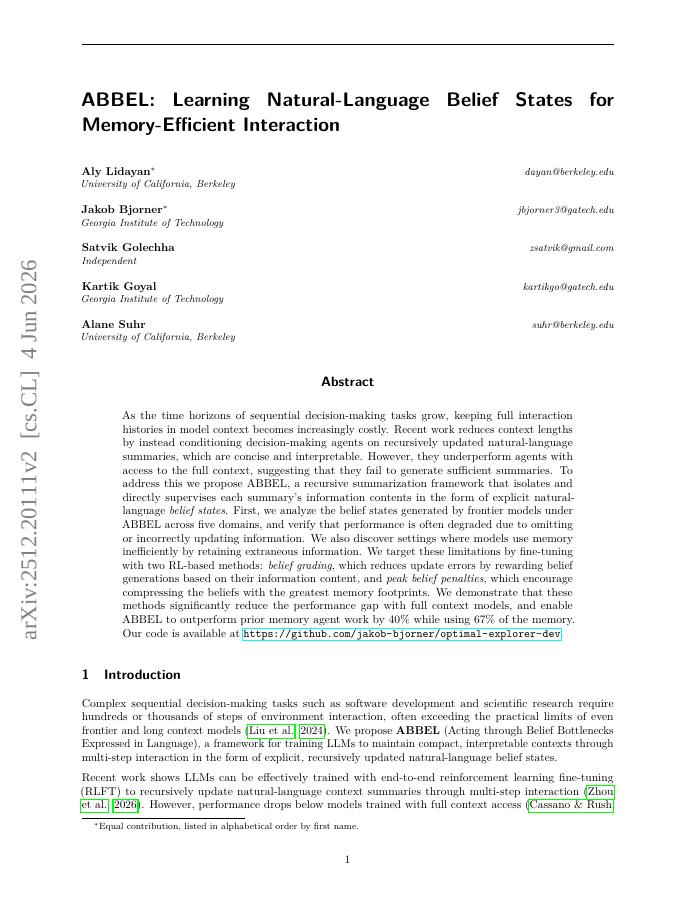
As the time horizons of sequential decision-making tasks grow, keeping full interaction histories in model context becomes increasingly costly. Recent work reduces context lengths by instead conditioning decision-making agents on recursively updated natural-language summaries, which are concise and interpretable. However, they underperform agents with access to the full context, suggesting that they fail to generate sufficient summaries. To address this we propose ABBEL, a recursive summarization framework that isolates and directly supervises each summary's information contents in the form of explicit natural-language belief states. First, we analyze the belief states generated by frontier models under ABBEL across five domains, and verify that performance is often degraded due to omitting or incorrectly updating information. We also discover settings where models use memory inefficiently by retaining extraneous information. We target these limitations by fine-tuning with two RL-based methods: belief grading, which reduces update errors by rewarding belief generations based on their information content, and peak belief penalties, which encourage compressing the beliefs with the greatest memory footprints. We demonstrate that these methods significantly reduce the performance gap with full context models, and enable ABBEL to outperform prior memory agent work by 40% while using 67% of the memory. Our code is available at https://github.com/jakob-bjorner/optimal-explorer-dev
ABBEL: Learning Natural-Language Belief States for Memory-Efficient Interaction
As the time horizons of sequential decision-making tasks grow, keeping full interaction histories in model context becomes increasingly costly. Recent work reduces context lengths by instead conditioning decision-making agents on recursively updated natural-language summaries,…
- Preview
- Year
- 2025
- Hosting
- Abstract onlyARXIV-DEFAULT
Cite
Notes
Only stored in your browser.
Attribution
- Abstract & full text
- arxiv.org/abs/2512.20111ARXIV-DEFAULT
- TL;DR
- Semantic Scholar