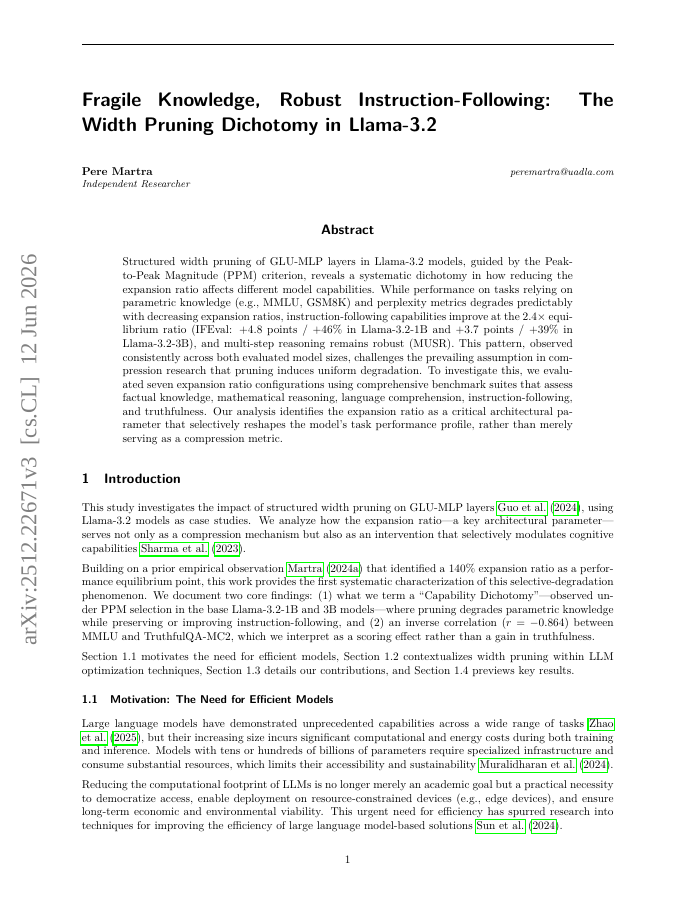
Structured width pruning of GLU-MLP layers in Llama-3.2 models, guided by the Peak-to-Peak Magnitude (PPM) criterion, reveals a systematic dichotomy in how reducing the expansion ratio affects different model capabilities. While performance on tasks relying on parametric knowledge (e.g., MMLU, GSM8K) and perplexity metrics degrades predictably with decreasing expansion ratios, instruction-following capabilities improve at the 2.4x equilibrium ratio (IFEval: +4.8 points / +46% in Llama-3.2-1B and +3.7 points / +39% in Llama-3.2-3B), and multi-step reasoning remains robust (MUSR). This pattern, observed consistently across both evaluated model sizes, challenges the prevailing assumption in compression research that pruning induces uniform degradation. To investigate this, we evaluated seven expansion ratio configurations using comprehensive benchmark suites that assess factual knowledge, mathematical reasoning, language comprehension, instruction-following, and truthfulness. Our analysis identifies the expansion ratio as a critical architectural parameter that selectively reshapes the model's task performance profile, rather than merely serving as a compression metric.
Fragile Knowledge, Robust Instruction-Following: The Width Pruning Dichotomy in Llama-3.2
Structured width pruning of GLU-MLP layers in Llama-3.2 models, guided by the Peak-to-Peak Magnitude (PPM) criterion, reveals a systematic dichotomy in how reducing the expansion ratio affects different model capabilities.
- Preview
- Year
- 2025
- Hosting
- Full text hostedCC-BY-4.0
Cite
Notes
Only stored in your browser.
Attribution
- Abstract & full text
- arxiv.org/abs/2512.22671CC-BY-4.0
- TL;DR
- Semantic Scholar