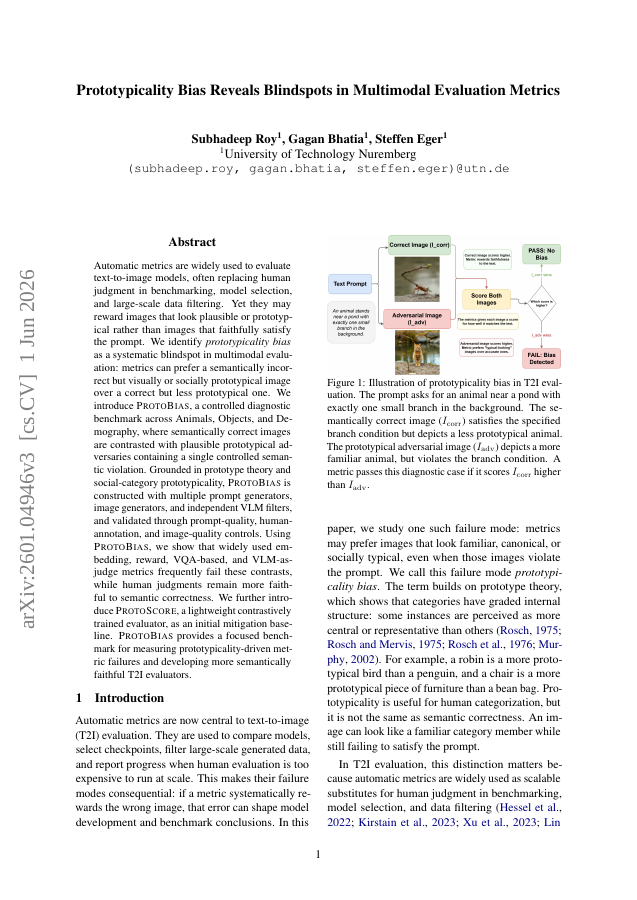
Automatic metrics are widely used to evaluate text-to-image models, often replacing human judgment in benchmarking, model selection, and large-scale data filtering. Yet they may reward images that look plausible or prototypical rather than images that faithfully satisfy the prompt. We identify prototypicality bias as a systematic blindspot in multimodal evaluation: metrics can prefer a semantically incorrect but visually or socially prototypical image over a correct but less prototypical one. We introduce PROTOBIAS, a controlled diagnostic benchmark across Animals, Objects, and Demography, where semantically correct images are contrasted with plausible prototypical adversaries containing a single controlled semantic violation. Grounded in prototype theory and social-category prototypicality, PROTOBIAS is constructed with multiple prompt generators, image generators, and independent VLM filters, and validated through prompt-quality, human-annotation, and image-quality controls. Using PROTOBIAS, we show that widely used embedding, reward, VQA-based, and VLM-as-judge metrics frequently fail these contrasts, while human judgments remain more faithful to semantic correctness. We further introduce PROTOSCORE, a lightweight contrastively trained evaluator, as an initial mitigation baseline. PROTOBIAS provides a focused benchmark for measuring prototypicality-driven metric failures and developing more semantically faithful T2I evaluators.
Prototypicality Bias Reveals Blindspots in Multimodal Evaluation Metrics
Automatic metrics are widely used to evaluate text-to-image models, often replacing human judgment in benchmarking, model selection, and large-scale data filtering. Yet they may reward images that look plausible or prototypical rather than images that faithfully satisfy the…
- Preview
- Year
- 2026
- Hosting
- Full text hostedCC-BY-SA-4.0
Cite
Notes
Only stored in your browser.
Attribution
- Abstract & full text
- arxiv.org/abs/2601.04946CC-BY-SA-4.0
- TL;DR
- Semantic Scholar