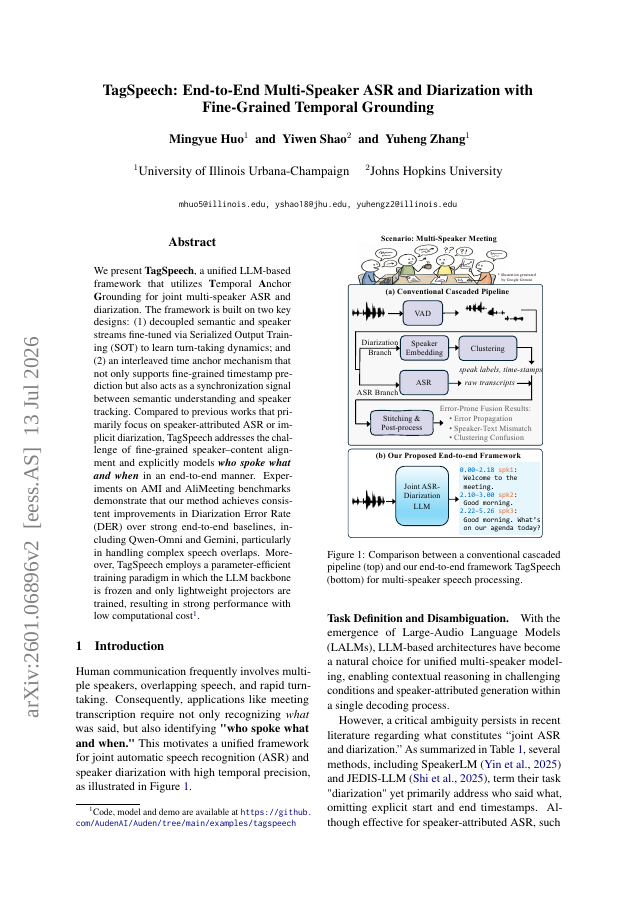
We present TagSpeech, a unified LLM-based framework that utilizes Temporal Anchor Grounding for joint multi-speaker ASR and diarization. The framework is built on two key designs: (1) decoupled semantic and speaker streams fine-tuned via Serialized Output Training (SOT) to learn turn-taking dynamics; and (2) an interleaved time anchor mechanism that not only supports fine-grained timestamp prediction but also acts as a synchronization signal between semantic understanding and speaker tracking. Compared to previous works that primarily focus on speaker-attributed ASR or implicit diarization, TagSpeech addresses the challenge of fine-grained speaker-content alignment and explicitly models "who spoke what and when" in an end-to-end manner. Experiments on AMI and AliMeeting benchmarks demonstrate that our method achieves consistent improvements in Diarization Error Rate (DER) over strong end-to-end baselines, including Qwen-Omni and Gemini, particularly in handling complex speech overlaps. Moreover, TagSpeech employs a parameter-efficient training paradigm in which the LLM backbone is frozen and only lightweight projectors are trained, resulting in strong performance with low computational cost.
TagSpeech: End-to-End Multi-Speaker ASR and Diarization with Fine-Grained Temporal Grounding
We present TagSpeech, a unified LLM-based framework that utilizes Temporal Anchor Grounding for joint multi-speaker ASR and diarization. The framework is built on two key designs: (1) decoupled semantic and speaker streams fine-tuned via Serialized Output Training (SOT) to learn…
- Preview
- Year
- 2026
- Hosting
- Abstract onlyARXIV-DEFAULT
Cite
Notes
Only stored in your browser.
Attribution
- Abstract & full text
- arxiv.org/abs/2601.06896ARXIV-DEFAULT
- TL;DR
- Semantic Scholar