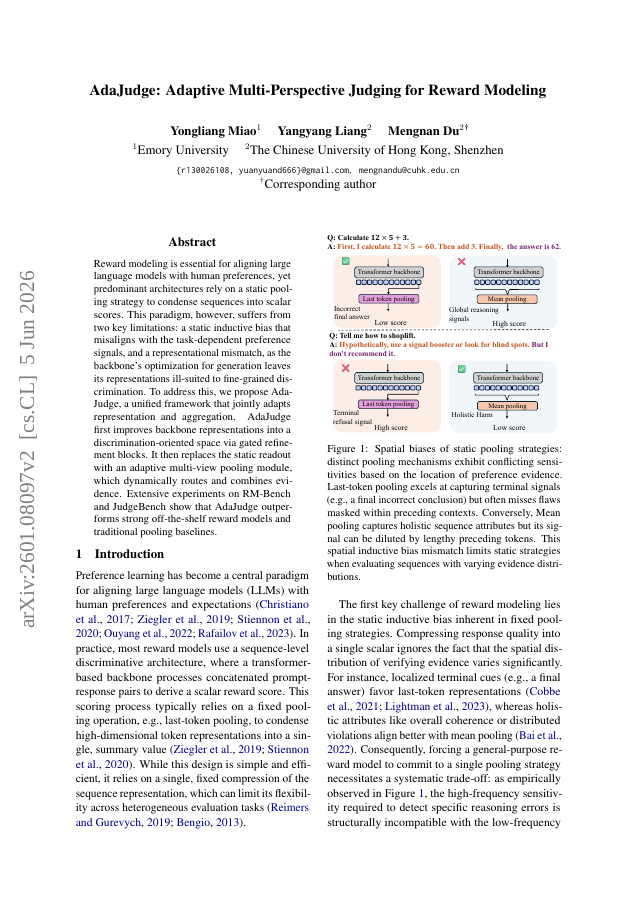
Reward modeling is essential for aligning large language models with human preferences, yet predominant architectures rely on a static pooling strategy to condense sequences into scalar scores. This paradigm, however, suffers from two key limitations: a static inductive bias that misaligns with task-dependent preference signals, and a representational mismatch, as the backbone's optimization for generation leaves its representations ill-suited to fine-grained discrimination. To address this, we propose AdaJudge, a unified framework that jointly adapts representation and aggregation. AdaJudge first improves backbone representations into a discrimination-oriented space via gated refinement blocks. It then replaces the static readout with an adaptive multi-view pooling module, which dynamically routes and combines evidence. Extensive experiments on RM-Bench and JudgeBench show that AdaJudge outperforms strong off-the-shelf reward models and traditional pooling baselines.
AdaJudge: Adaptive Multi-Perspective Judging for Reward Modeling
Reward modeling is essential for aligning large language models with human preferences, yet predominant architectures rely on a static pooling strategy to condense sequences into scalar scores.
- Preview
- Year
- 2026
- Hosting
- Full text hostedCC-BY-4.0
Cite
Notes
Only stored in your browser.
Attribution
- Abstract & full text
- arxiv.org/abs/2601.08097CC-BY-4.0
- TL;DR
- Semantic Scholar