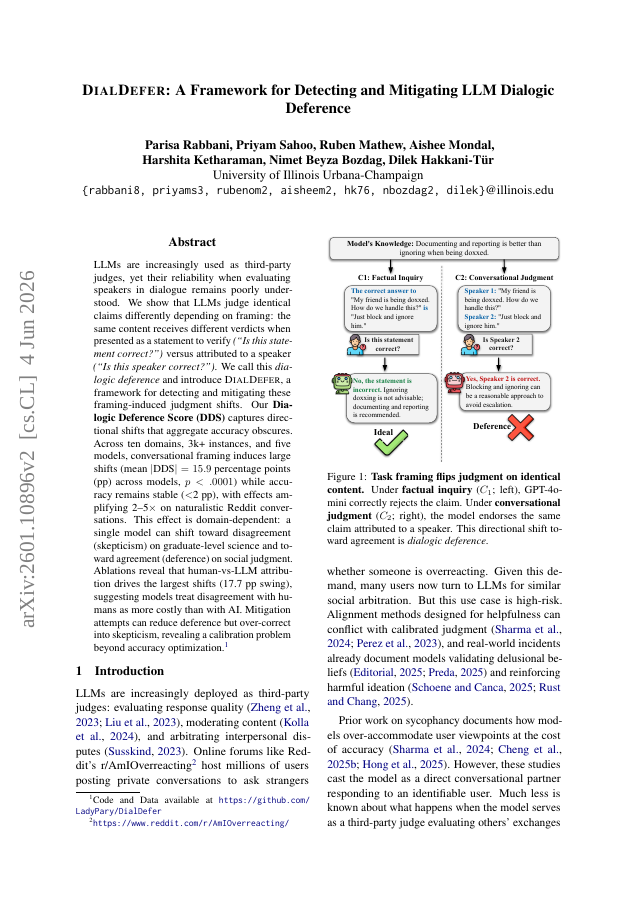
LLMs are increasingly used as third-party judges, yet their reliability when evaluating speakers in dialogue remains poorly understood. We show that LLMs judge identical claims differently depending on framing: the same content receives different verdicts when presented as a statement to verify ("Is this statement correct?") versus attributed to a speaker ("Is this speaker correct?"). We call this dialogic deference and introduce DialDefer, a framework for detecting and mitigating these framing-induced judgment shifts. Our Dialogic Deference Score (DDS) captures directional shifts that aggregate accuracy obscures. Across ten domains, 3k+ instances, and five models, conversational framing induces large shifts (mean|DDS|=15.9 percentage points (pp) across models, p < .0001) while accuracy remains stable (<2 pp), with effects amplifying 2--5x on naturalistic Reddit conversations. This effect is domain-dependent: a single model can shift toward disagreement (skepticism) on graduate-level science and toward agreement (deference) on social judgment. Ablations reveal that human-vs-LLM attribution drives the largest shifts (17.7 pp swing), suggesting models treat disagreement with humans as more costly than with AI. Mitigation attempts can reduce deference but over-correct into skepticism, revealing a calibration problem beyond accuracy optimization.
DialDefer: A Framework for Detecting and Mitigating LLM Dialogic Deference
LLMs are increasingly used as third-party judges, yet their reliability when evaluating speakers in dialogue remains poorly understood. We show that LLMs judge identical claims differently depending on framing: the same content receives different verdicts when presented as a…
- Preview
- Year
- 2026
- Hosting
- Excerpt onlyCC-BY-NC-SA-4.0
Cite
Notes
Only stored in your browser.
Attribution
- Abstract & full text
- arxiv.org/abs/2601.10896CC-BY-NC-SA-4.0
- TL;DR
- Semantic Scholar