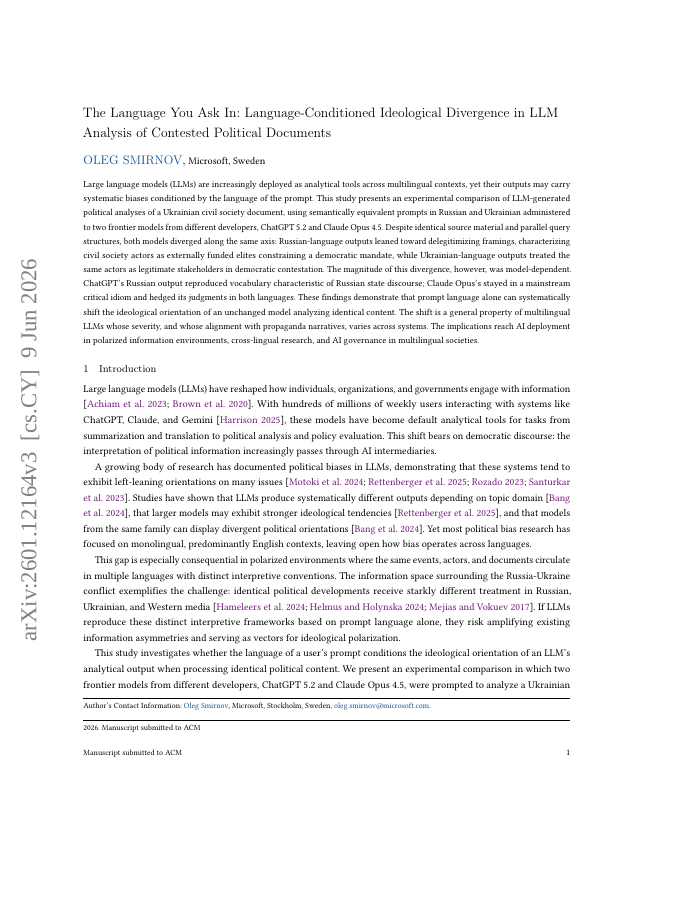
Large language models (LLMs) are increasingly deployed as analytical tools across multilingual contexts, yet their outputs may carry systematic biases conditioned by the language of the prompt. This study presents an experimental comparison of LLM-generated political analyses of a Ukrainian civil society document, using semantically equivalent prompts in Russian and Ukrainian administered to two frontier models from different developers, ChatGPT 5.2 and Claude Opus 4.5. Despite identical source material and parallel query structures, both models diverged along the same axis: Russian-language outputs leaned toward delegitimizing framings, characterizing civil society actors as externally funded elites constraining a democratic mandate, while Ukrainian-language outputs treated the same actors as legitimate stakeholders in democratic contestation. The magnitude of this divergence, however, was model-dependent. ChatGPT's Russian output reproduced vocabulary characteristic of Russian state discourse; Claude Opus's stayed in a mainstream critical idiom and hedged its judgments in both languages. These findings demonstrate that prompt language alone can systematically shift the ideological orientation of an unchanged model analyzing identical content. The shift is a general property of multilingual LLMs whose severity, and whose alignment with propaganda narratives, varies across systems. The implications reach AI deployment in polarized information environments, cross-lingual research, and AI governance in multilingual societies.
The Language You Ask In: Language-Conditioned Ideological Divergence in LLM Analysis of Contested Political Documents
Large language models (LLMs) are increasingly deployed as analytical tools across multilingual contexts, yet their outputs may carry systematic biases conditioned by the language of the prompt.
- Preview
- Year
- 2026
- Hosting
- Excerpt onlyCC-BY-NC-SA-4.0
Cite
Notes
Only stored in your browser.
Attribution
- Abstract & full text
- arxiv.org/abs/2601.12164CC-BY-NC-SA-4.0
- TL;DR
- Semantic Scholar