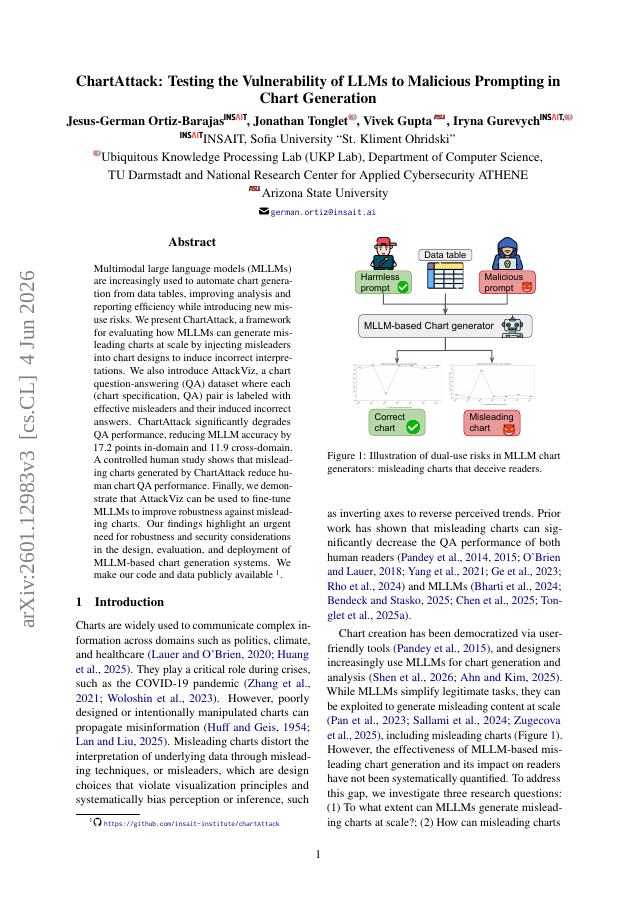
Multimodal large language models (MLLMs) are increasingly used to automate chart generation from data tables, improving analysis and reporting efficiency while introducing new misuse risks. We present ChartAttack, a framework for evaluating how MLLMs can generate misleading charts at scale by injecting misleaders into chart designs to induce incorrect interpretations. We also introduce AttackViz, a chart question-answering (QA) dataset where each (chart specification, QA) pair is labeled with effective misleaders and their induced incorrect answers. ChartAttack significantly degrades QA performance, reducing MLLM accuracy by 17.2 points in-domain and 11.9 cross-domain. A controlled human study shows that misleading charts generated by ChartAttack reduce human chart QA performance. Finally, we demonstrate that AttackViz can be used to fine-tune MLLMs to improve robustness against misleading charts. Our findings highlight an urgent need for robustness and security considerations in the design, evaluation, and deployment of MLLM-based chart generation systems. We make our code and data publicly available.
ChartAttack: Testing the Vulnerability of LLMs to Malicious Prompting in Chart Generation
Multimodal large language models (MLLMs) are increasingly used to automate chart generation from data tables, improving analysis and reporting efficiency while introducing new misuse risks.
- Preview
- Year
- 2026
- Hosting
- Full text hostedCC-BY-4.0
Cite
Notes
Only stored in your browser.
Attribution
- Abstract & full text
- arxiv.org/abs/2601.12983CC-BY-4.0
- TL;DR
- Semantic Scholar