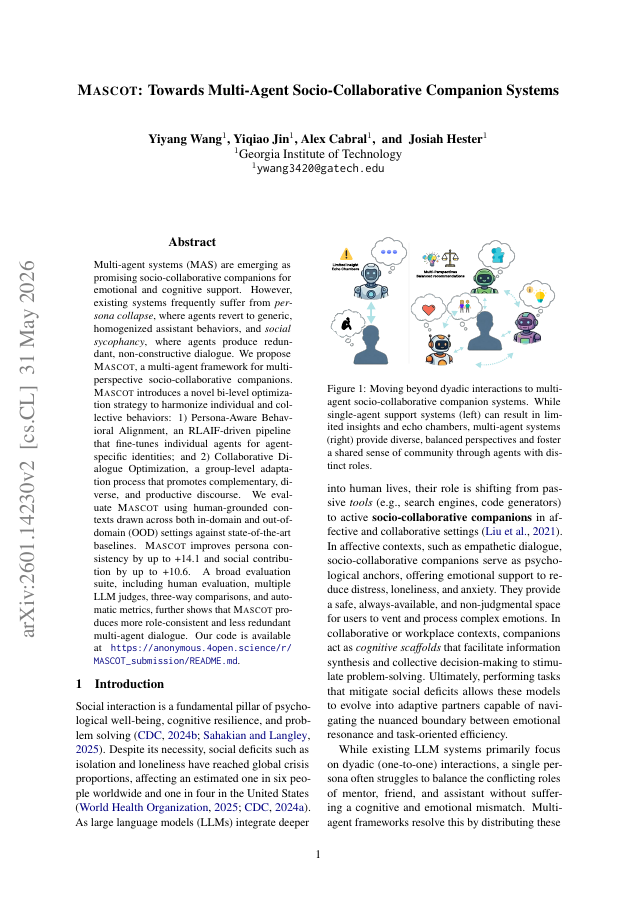
Multi-agent systems (MAS) are emerging as promising socio-collaborative companions for emotional and cognitive support. However, existing systems frequently suffer from persona collapse, where agents revert to generic, homogenized assistant behaviors, and social sycophancy, where agents produce redundant, non-constructive dialogue. We propose MASCOT, a multi-agent framework for multi-perspective socio-collaborative companions. MASCOT introduces a novel bi-level optimization strategy to harmonize individual and collective behaviors: 1) Persona-Aware Behavioral Alignment, an RLAIF-driven pipeline that fine-tunes individual agents for agent-specific identities; and 2) Collaborative Dialogue Optimization, a group-level adaptation process that promotes complementary, diverse, and productive discourse. We evaluate MASCOT using human-grounded contexts drawn across both in-domain and out-of-domain (OOD) settings against state-of-the-art baselines. MASCOT improves persona consistency by up to +14.1 and social contribution by up to +10.6. A broad evaluation suite, including human evaluation, multiple LLM judges, three-way comparisons, and automatic metrics, further shows that MASCOT produces more role-consistent and less redundant multi-agent dialogue.
MASCOT: Towards Multi-Agent Socio-Collaborative Companion Systems
Multi-agent systems (MAS) are emerging as promising socio-collaborative companions for emotional and cognitive support. However, existing systems frequently suffer from persona collapse, where agents revert to generic, homogenized assistant behaviors, and social sycophancy,…
- Preview
- Year
- 2026
- Hosting
- Full text hostedCC-BY-SA-4.0
Cite
Notes
Only stored in your browser.
Attribution
- Abstract & full text
- arxiv.org/abs/2601.14230CC-BY-SA-4.0
- TL;DR
- Semantic Scholar