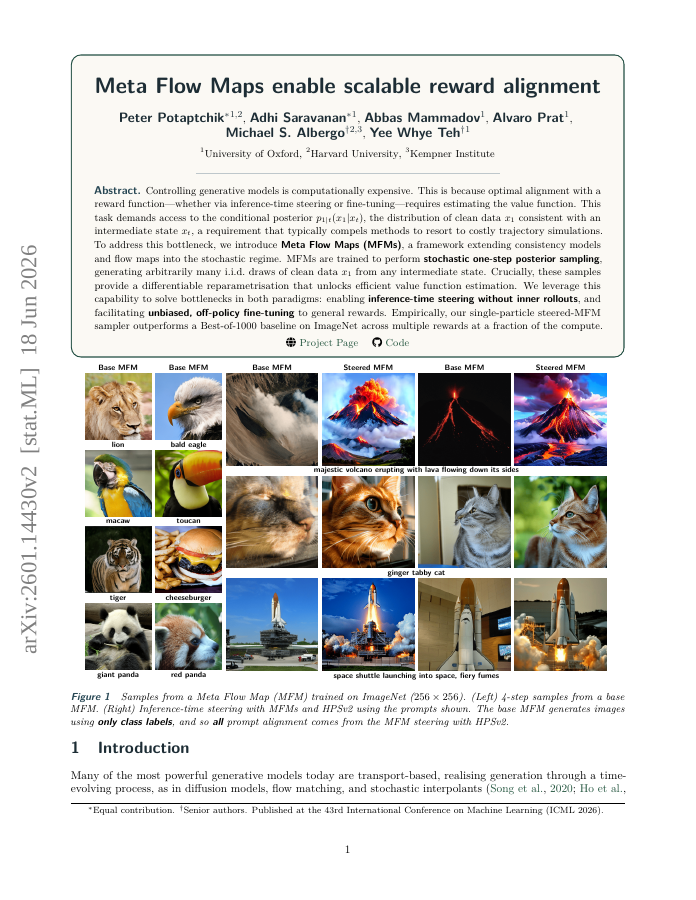
Controlling generative models is computationally expensive. This is because optimal alignment with a reward function--whether via inference-time steering or fine-tuning--requires estimating the value function. This task demands access to the conditional posterior p_{1|t}(x_1|x_t), the distribution of clean data x_1 consistent with an intermediate state x_t, a requirement that typically compels methods to resort to costly trajectory simulations. To address this bottleneck, we introduce Meta Flow Maps (MFMs), a framework extending consistency models and flow maps into the stochastic regime. MFMs are trained to perform stochastic one-step posterior sampling, generating arbitrarily many i.i.d. draws of clean data x_1 from any intermediate state. Crucially, these samples provide a differentiable reparametrization that unlocks efficient value function estimation. We leverage this capability to solve bottlenecks in both paradigms: enabling inference-time steering without inner rollouts, and facilitating unbiased, off-policy fine-tuning to general rewards. Empirically, our single-particle steered-MFM sampler outperforms a Best-of-1000 baseline on ImageNet across multiple rewards at a fraction of the compute.
Meta Flow Maps enable scalable reward alignment
Controlling generative models is computationally expensive. This is because optimal alignment with a reward function--whether via inference-time steering or fine-tuning--requires estimating the value function.
- Preview
- Year
- 2026
- Hosting
- Abstract onlyARXIV-DEFAULT
Cite
Notes
Only stored in your browser.
Attribution
- Abstract & full text
- arxiv.org/abs/2601.14430ARXIV-DEFAULT
- TL;DR
- Semantic Scholar