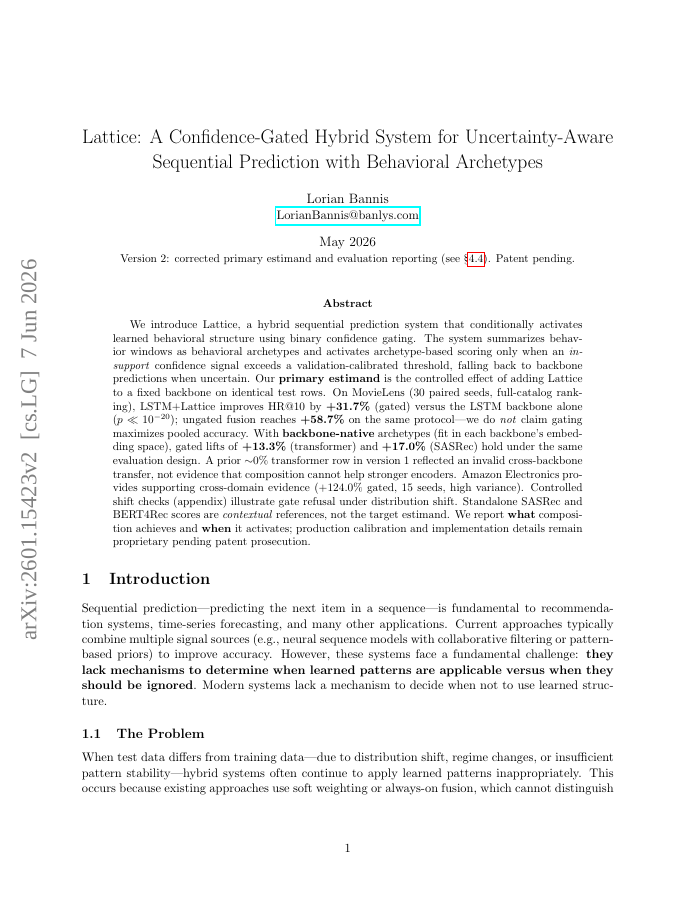
We introduce Lattice, a hybrid sequential prediction system that conditionally activates learned behavioral structure using binary confidence gating. The system summarizes behavior windows as behavioral archetypes and activates archetype-based scoring only when an in-support confidence signal exceeds a validation-calibrated threshold, falling back to backbone predictions when uncertain. Our primary estimand is the controlled effect of adding Lattice to a fixed backbone on identical test rows. On MovieLens (30 paired seeds, full-catalog ranking), LSTM+Lattice improves HR@10 by +31.7% (gated) versus the LSTM backbone alone (p much less than 10^-20); ungated fusion reaches +58.7% on the same protocol. We do not claim gating maximizes pooled accuracy. With backbone-native archetypes (fit in each backbone's embedding space), gated lifts of +13.3% (transformer) and +17.0% (SASRec) hold under the same evaluation design. A prior approximately 0% transformer row in version 1 reflected an invalid cross-backbone transfer, not evidence that composition cannot help stronger encoders. Amazon Electronics provides supporting cross-domain evidence (+124.0% gated, 15 seeds, high variance). Controlled shift checks (appendix) illustrate gate refusal under distribution shift. Standalone SASRec and BERT4Rec scores are contextual references, not the target estimand. We report what composition achieves and when it activates; production calibration and implementation details remain proprietary pending patent prosecution.
Lattice: A Confidence-Gated Hybrid System for Uncertainty-Aware Sequential Prediction with Behavioral Archetypes
We introduce Lattice, a hybrid sequential prediction system that conditionally activates learned behavioral structure using binary confidence gating. The system summarizes behavior windows as behavioral archetypes and activates archetype-based scoring only when an in-support…
- Preview
- Year
- 2026
- Hosting
- Abstract onlyARXIV-DEFAULT
Cite
Notes
Only stored in your browser.
Attribution
- Abstract & full text
- arxiv.org/abs/2601.15423ARXIV-DEFAULT
- TL;DR
- Semantic Scholar