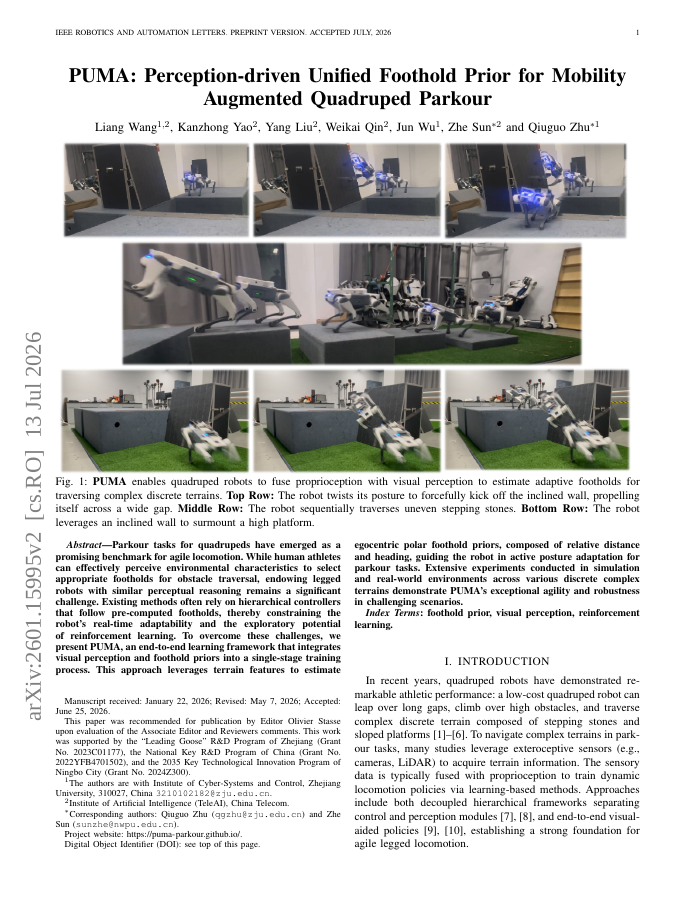
Parkour tasks for quadrupeds have emerged as a promising benchmark for agile locomotion. While human athletes can effectively perceive environmental characteristics to select appropriate footholds for obstacle traversal, endowing legged robots with similar perceptual reasoning remains a significant challenge. Existing methods often rely on hierarchical controllers that follow pre-computed footholds, thereby constraining the robot's real-time adaptability and the exploratory potential of reinforcement learning. To overcome these challenges, we present PUMA, an end-to-end learning framework that integrates visual perception and foothold priors into a single-stage training process. This approach leverages terrain features to estimate egocentric polar foothold priors, composed of relative distance and heading, guiding the robot in active posture adaptation for parkour tasks. Extensive experiments conducted in simulation and real-world environments across various discrete complex terrains, demonstrate PUMA's exceptional agility and robustness in challenging scenarios.
PUMA: Perception-driven Unified Foothold Prior for Mobility Augmented Quadruped Parkour
Parkour tasks for quadrupeds have emerged as a promising benchmark for agile locomotion. While human athletes can effectively perceive environmental characteristics to select appropriate footholds for obstacle traversal, endowing legged robots with similar perceptual reasoning…
- Preview
- Year
- 2026
- Hosting
- Abstract onlyARXIV-DEFAULT
Cite
Notes
Only stored in your browser.
Attribution
- Abstract & full text
- arxiv.org/abs/2601.15995ARXIV-DEFAULT
- TL;DR
- Semantic Scholar