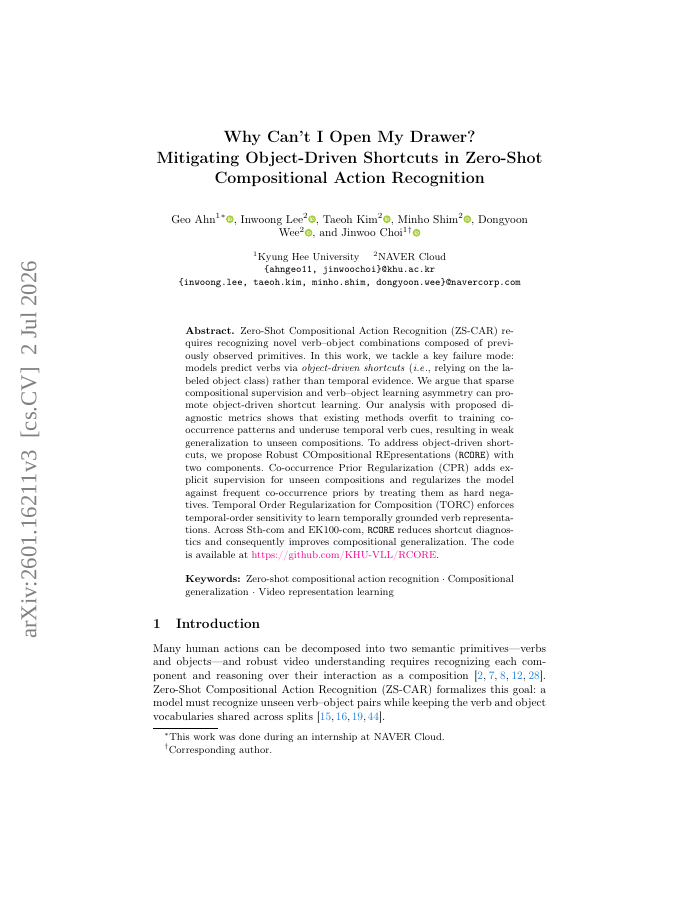
Zero-Shot Compositional Action Recognition (ZS-CAR) requires recognizing novel verb-object combinations composed of previously observed primitives. In this work, we tackle a key failure mode: models predict verbs via object-driven shortcuts (i.e., relying on the labeled object class) rather than temporal evidence. We argue that sparse compositional supervision and verb-object learning asymmetry can promote object-driven shortcut learning. Our analysis with proposed diagnostic metrics shows that existing methods overfit to training co-occurrence patterns and underuse temporal verb cues, resulting in weak generalization to unseen compositions. To address object-driven shortcuts, we propose Robust COmpositional REpresentations (RCORE) with two components. Co-occurrence Prior Regularization (CPR) adds explicit supervision for unseen compositions and regularizes the model against frequent co-occurrence priors by treating them as hard negatives. Temporal Order Regularization for Composition (TORC) enforces temporal-order sensitivity to learn temporally grounded verb representations. Across Sth-com and EK100-com, RCORE reduces shortcut diagnostics and consequently improves compositional generalization.
Why Can't I Open My Drawer? Mitigating Object-Driven Shortcuts in Zero-Shot Compositional Action Recognition
Zero-Shot Compositional Action Recognition (ZS-CAR) requires recognizing novel verb-object combinations composed of previously observed primitives. In this work, we tackle a key failure mode: models predict verbs via object-driven shortcuts (i.e., relying on the labeled object…
- Preview
- Year
- 2026
- Hosting
- Full text hostedCC-BY-4.0
Cite
Notes
Only stored in your browser.
Attribution
- Abstract & full text
- arxiv.org/abs/2601.16211CC-BY-4.0
- TL;DR
- Semantic Scholar