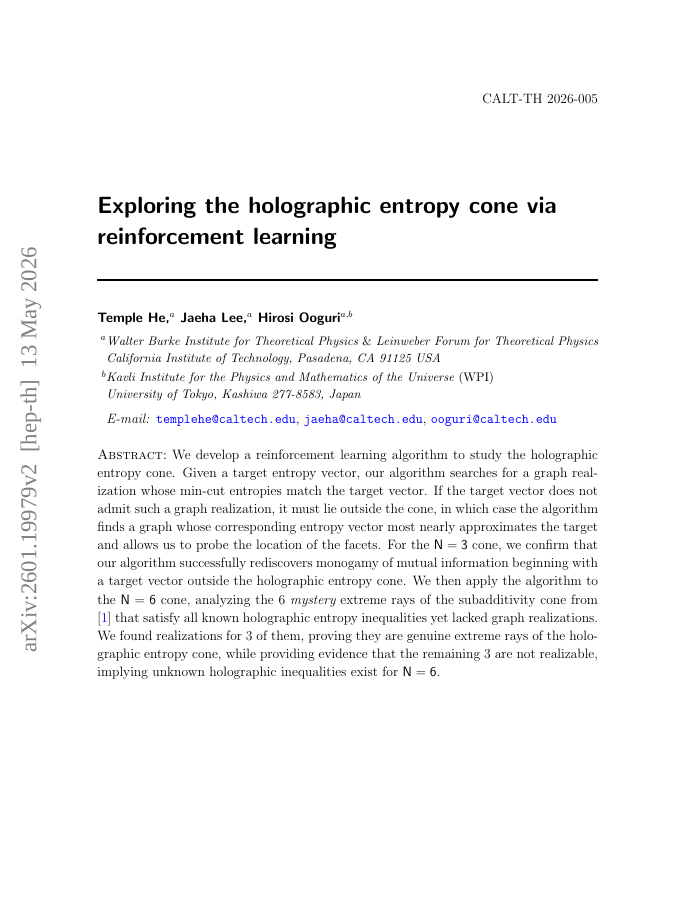
We develop a reinforcement learning algorithm to study the holographic entropy cone. Given a target entropy vector, our algorithm searches for a graph realization whose min-cut entropies match the target vector. If the target vector does not admit such a graph realization, it must lie outside the cone, in which case the algorithm finds a graph whose corresponding entropy vector most nearly approximates the target and allows us to probe the location of the facets. For the \sf N=3 cone, we confirm that our algorithm successfully rediscovers monogamy of mutual information beginning with a target vector outside the holographic entropy cone. We then apply the algorithm to the \sf N=6 cone, analyzing the 6 "mystery" extreme rays of the subadditivity cone from arXiv:2412.15364 that satisfy all known holographic entropy inequalities yet lacked graph realizations. We found realizations for 3 of them, proving they are genuine extreme rays of the holographic entropy cone, while providing evidence that the remaining 3 are not realizable, implying unknown holographic inequalities exist for \sf N=6.
Exploring the holographic entropy cone via reinforcement learning
We develop a reinforcement learning algorithm to study the holographic entropy cone. Given a target entropy vector, our algorithm searches for a graph realization whose min-cut entropies match the target vector.
- Preview
- Year
- 2026
- Hosting
- Full text hostedCC-BY-4.0
Cite
Notes
Only stored in your browser.
Attribution
- Abstract & full text
- arxiv.org/abs/2601.19979CC-BY-4.0
- TL;DR
- Semantic Scholar