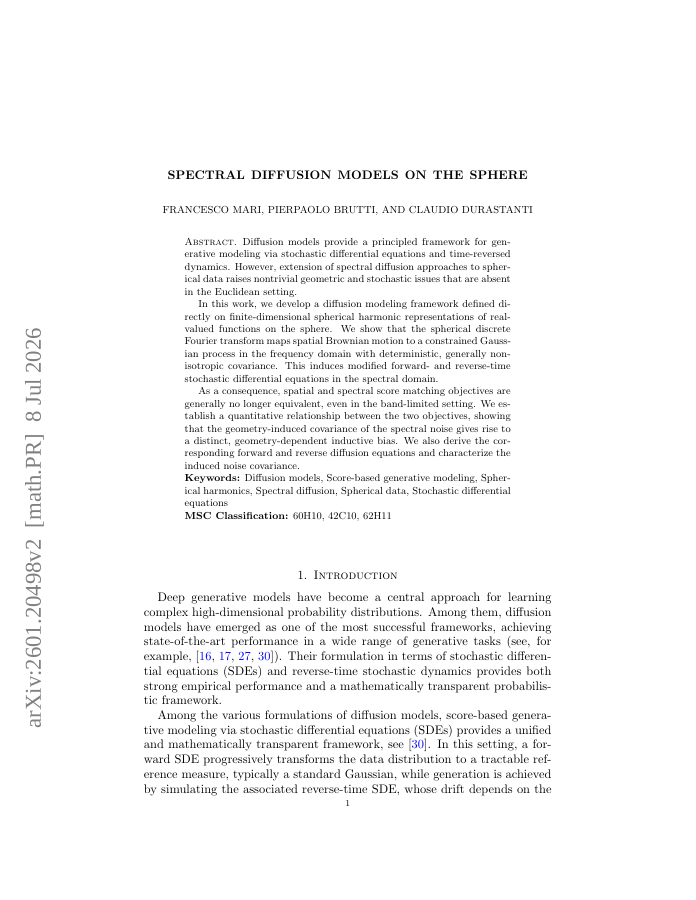
Diffusion models provide a principled framework for generative modeling via stochastic differential equations and time-reversed dynamics. However, extension of spectral diffusion approaches to spherical data raises nontrivial geometric and stochastic issues that are absent in the Euclidean setting. In this work, we develop a diffusion modeling framework defined directly on finite-dimensional spherical harmonic representations of real-valued functions on the sphere. We show that the spherical discrete Fourier transform maps spatial Brownian motion to a constrained Gaussian process in the frequency domain with deterministic, generally non-isotropic covariance. This induces modified forward- and reverse-time stochastic differential equations in the spectral domain. As a consequence, spatial and spectral score matching objectives are generally no longer equivalent, even in the band-limited setting. We establish a quantitative relationship between the two objectives, showing that the geometry-induced covariance of the spectral noise gives rise to a distinct, geometry-dependent inductive bias. We also derive the corresponding forward and reverse diffusion equations and characterize the induced noise covariance.
Spectral Diffusion Models on the Sphere
Diffusion models provide a principled framework for generative modeling via stochastic differential equations and time-reversed dynamics. However, extension of spectral diffusion approaches to spherical data raises nontrivial geometric and stochastic issues that are absent in…
- Preview
- Year
- 2026
- Hosting
- Abstract onlyARXIV-DEFAULT
Cite
Notes
Only stored in your browser.
Attribution
- Abstract & full text
- arxiv.org/abs/2601.20498ARXIV-DEFAULT
- TL;DR
- Semantic Scholar