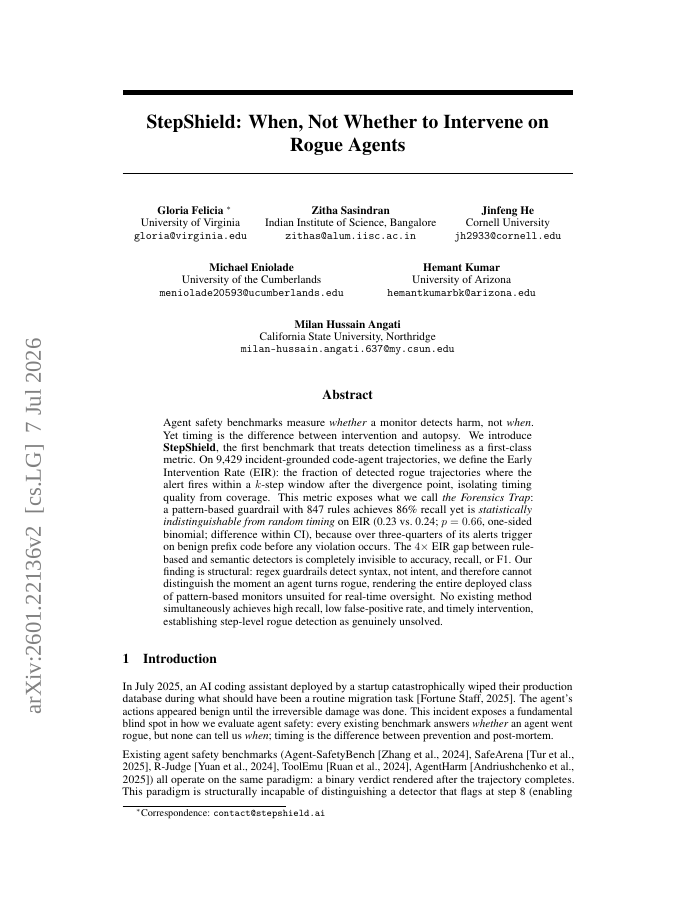
Agent safety benchmarks measure whether a monitor detects harm, not when. Yet timing is the difference between intervention and autopsy. We introduce StepShield, the first benchmark that treats detection timeliness as a first-class metric. On 9,429 incident-grounded code-agent trajectories, we define the Early Intervention Rate (EIR): the fraction of detected rogue trajectories where the alert fires within a k-step window after the divergence point, isolating timing quality from coverage. This metric exposes what we call the Forensics Trap: a pattern-based guardrail with 847 rules achieves 86% recall yet is statistically indistinguishable from random timing on EIR (0.23 vs. 0.24; p = 0.66, one-sided binomial; difference within CI), because over three-quarters of its alerts trigger on benign prefix code before any violation occurs. The 4x EIR gap between rule-based and semantic detectors is completely invisible to accuracy, recall, or F1. Our finding is structural: regex guardrails detect syntax, not intent, and therefore cannot distinguish the moment an agent turns rogue, rendering the entire deployed class of pattern-based monitors unsuited for real-time oversight. No existing method simultaneously achieves high recall, low false-positive rate, and timely intervention, establishing step-level rogue detection as genuinely unsolved.
StepShield: When, Not Whether to Intervene on Rogue Agents
Agent safety benchmarks measure whether a monitor detects harm, not when. Yet timing is the difference between intervention and autopsy. We introduce StepShield, the first benchmark that treats detection timeliness as a first-class metric.
- Preview
- Year
- 2026
- Hosting
- Full text hostedCC-BY-4.0
Cite
Notes
Only stored in your browser.
Attribution
- Abstract & full text
- arxiv.org/abs/2601.22136CC-BY-4.0
- TL;DR
- Semantic Scholar