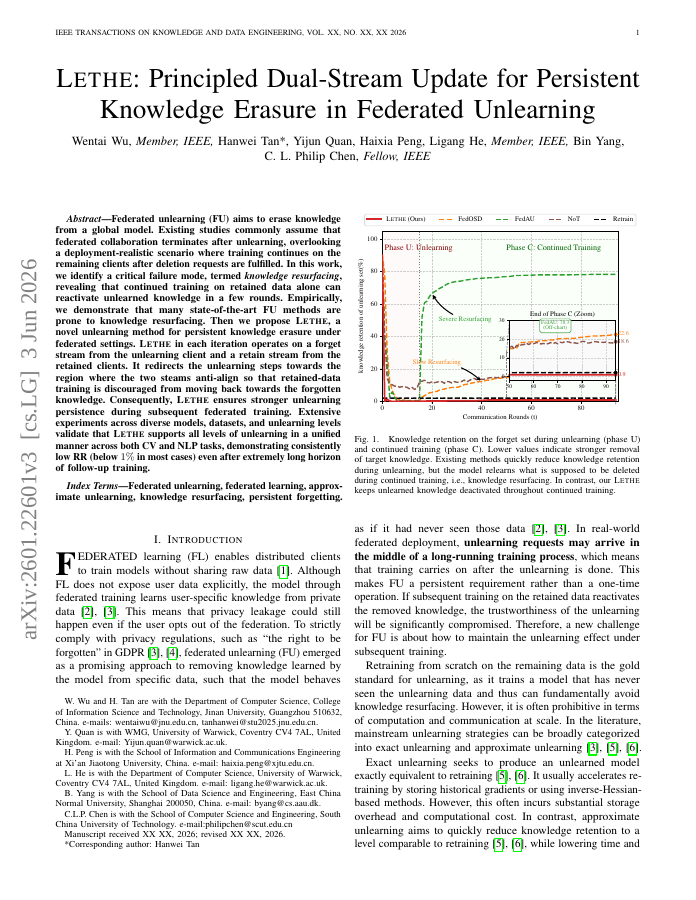
Federated unlearning (FU) aims to erase knowledge from a global model. Existing studies commonly assume that federated collaboration terminates after unlearning, overlooking a deployment-realistic scenario where training continues on the remaining clients after deletion requests are fulfilled. In this work, we identify a critical failure mode, termed knowledge resurfacing, revealing that continued training on retained data alone can reactivate unlearned knowledge in a few rounds. Empirically, we demonstrate that many state-of-the-art FU methods are prone to knowledge resurfacing. We then propose Lethe, a novel unlearning method for persistent knowledge erasure in federated settings. In each iteration, Lethe operates on a forget stream from the unlearning client and a retain stream from the retained clients. It redirects unlearning updates toward a region where the two streams are anti-aligned, discouraging retained-data training from moving back toward the forgotten knowledge. Consequently, Lethe ensures stronger unlearning persistence during subsequent federated training. Extensive experiments across diverse models, datasets, and unlearning levels validate that Lethe supports all levels of unlearning in a unified manner across both CV and NLP tasks, demonstrating consistently low RR, below 1% in most cases, even after an extremely long horizon of follow-up training.
\textsc{Lethe}: Principled Dual-Stream Update for Persistent Knowledge Erasure in Federated Unlearning
Federated unlearning (FU) aims to erase knowledge from a global model. Existing studies commonly assume that federated collaboration terminates after unlearning, overlooking a deployment-realistic scenario where training continues on the remaining clients after deletion requests…
- Preview
- Year
- 2026
- Hosting
- Excerpt onlyCC-BY-NC-SA-4.0
Cite
Notes
Only stored in your browser.
Attribution
- Abstract & full text
- arxiv.org/abs/2601.22601CC-BY-NC-SA-4.0
- TL;DR
- Semantic Scholar