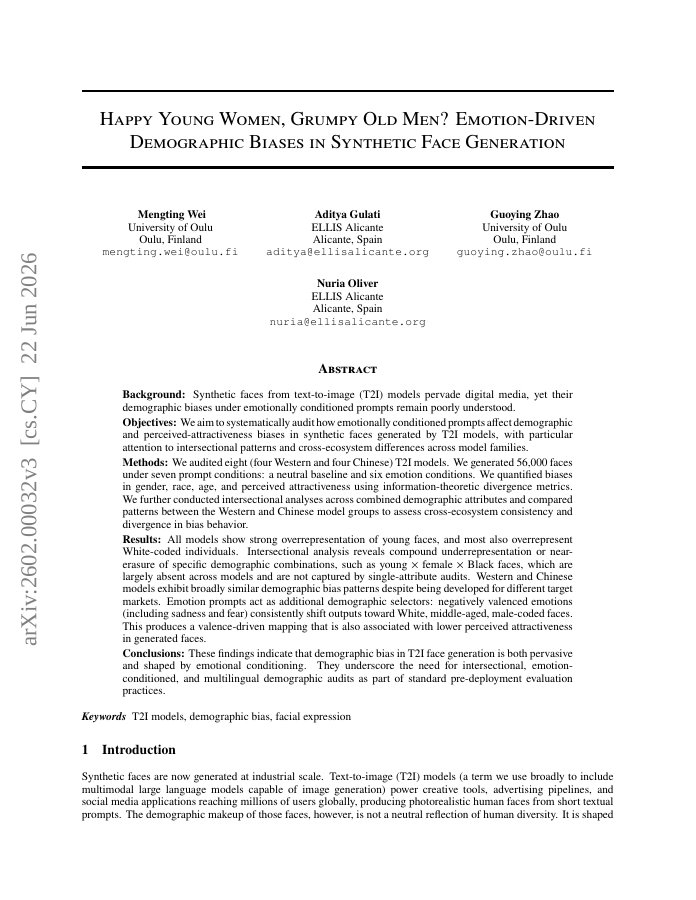
Synthetic faces from text-to-image (T2I) models pervade digital media, yet their demographic biases under emotionally conditioned prompts remain poorly understood. We aim to systematically audit how emotionally conditioned prompts affect demographic and perceived-attractiveness biases in synthetic faces generated by T2I models, with particular attention to intersectional patterns and cross-ecosystem differences across model families. We audited eight (4 Western and 4 Chinese) T2I models and generated 56,000 faces under seven prompt conditions: a neutral baseline and six emotion conditions. We quantified biases in gender, race, age, and perceived attractiveness using information-theoretic divergence metrics. We further conducted intersectional analyses across combined demographic attributes and compared patterns between the Western and Chinese model groups to assess cross-ecosystem consistency and divergence in bias behavior. All models show strong overrepresentation of young faces, and most also overrepresent White-coded individuals. Intersectional analysis reveals compound underrepresentation or near-erasure of specific demographic combinations, such as young x female x Black faces, which are largely absent across models and are not captured by single-attribute audits. Emotion prompts act as additional demographic selectors: negatively valenced emotions (including sadness and fear) consistently shift outputs toward White, middle-aged, male-coded faces. This produces a valence-driven mapping that is also associated with lower perceived attractiveness in generated faces. These findings indicate that demographic bias in T2I face generation is both pervasive and shaped by emotional conditioning. They underscore the need for intersectional, emotion-conditioned, and multilingual demographic audits as part of standard pre-deployment evaluation practices.
Happy Young Women, Grumpy Old Men? Emotion-Driven Demographic Biases in Synthetic Face Generation
Synthetic faces from text-to-image (T2I) models pervade digital media, yet their demographic biases under emotionally conditioned prompts remain poorly understood. We aim to systematically audit how emotionally conditioned prompts affect demographic and perceived-attractiveness…
- Preview
- Year
- 2026
- Hosting
- Full text hostedCC-BY-4.0
Cite
Notes
Only stored in your browser.
Attribution
- Abstract & full text
- arxiv.org/abs/2602.00032CC-BY-4.0
- TL;DR
- Semantic Scholar