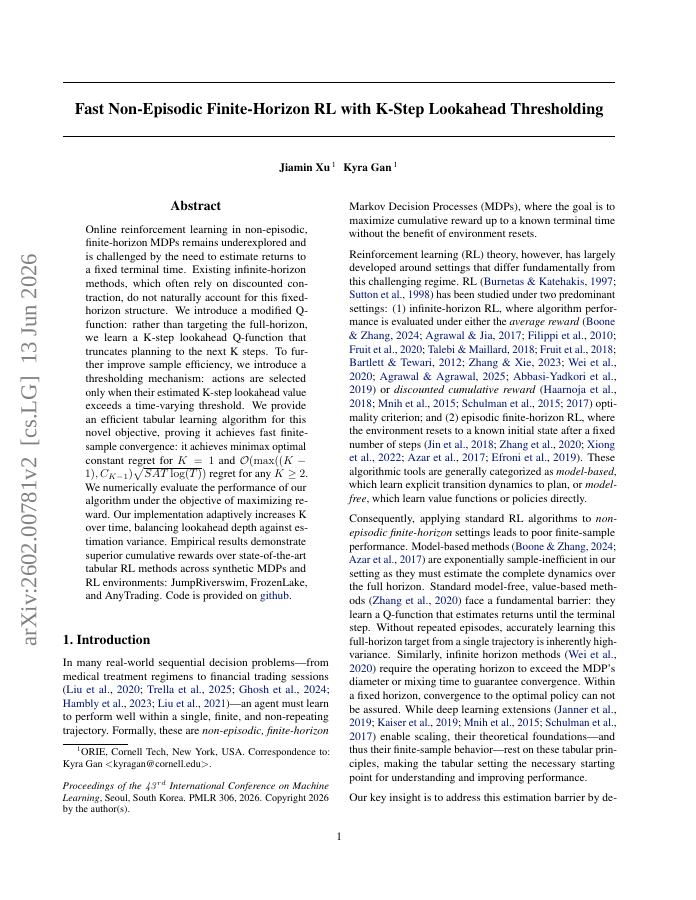
Online reinforcement learning in non-episodic, finite-horizon MDPs remains underexplored and is challenged by the need to estimate returns to a fixed terminal time. Existing infinite-horizon methods, which often rely on discounted contraction, do not naturally account for this fixed-horizon structure. We introduce a modified Q-function: rather than targeting the full-horizon, we learn a K-step lookahead Q-function that truncates planning to the next K steps. To further improve sample efficiency, we introduce a thresholding mechanism: actions are selected only when their estimated K-step lookahead value exceeds a time-varying threshold. We provide an efficient tabular learning algorithm for this novel objective, proving it achieves fast finite-sample convergence: it achieves minimax optimal constant regret for K=1 and O(\max((K-1),C_{K-1})\sqrt{SAT\log(T)}) regret for any K \geq 2. We numerically evaluate the performance of our algorithm under the objective of maximizing reward. Our implementation adaptively increases K over time, balancing lookahead depth against estimation variance. Empirical results demonstrate superior cumulative rewards over state-of-the-art tabular RL methods across synthetic MDPs and RL environments: JumpRiverswim, FrozenLake and AnyTrading. Code is provided on github.
Fast Non-Episodic Finite-Horizon RL with K-Step Lookahead Thresholding
Online reinforcement learning in non-episodic, finite-horizon MDPs remains underexplored and is challenged by the need to estimate returns to a fixed terminal time. Existing infinite-horizon methods, which often rely on discounted contraction, do not naturally account for this…
- Preview
- Year
- 2026
- Hosting
- Excerpt onlyCC-BY-NC-4.0
Cite
Notes
Only stored in your browser.
Attribution
- Abstract & full text
- arxiv.org/abs/2602.00781CC-BY-NC-4.0
- TL;DR
- Semantic Scholar