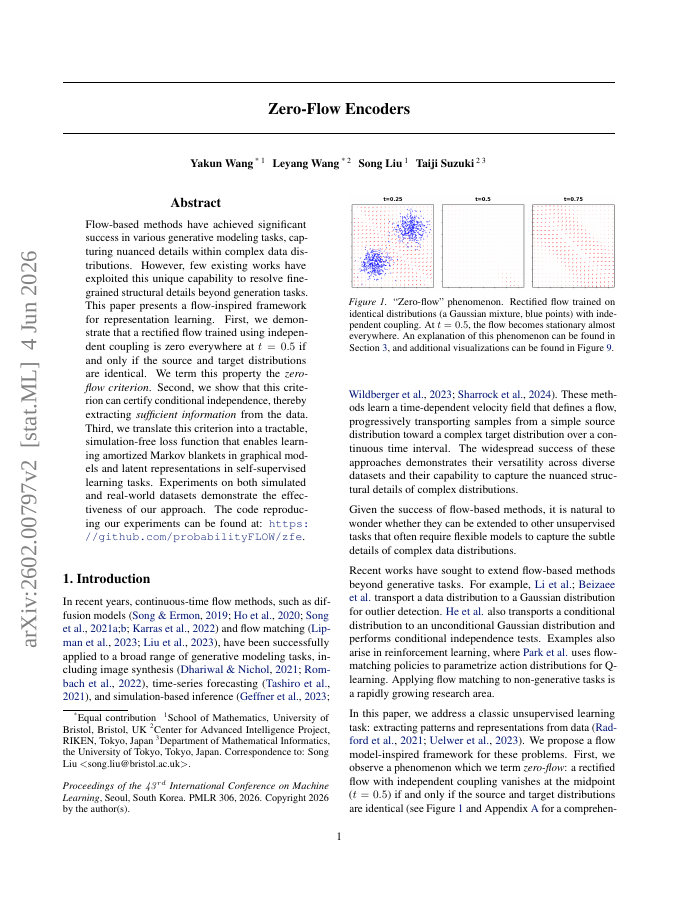
Flow-based methods have achieved significant success in various generative modeling tasks, capturing nuanced details within complex data distributions. However, few existing works have exploited this unique capability to resolve fine-grained structural details beyond generation tasks. This paper presents a flow-inspired framework for representation learning. First, we demonstrate that a rectified flow trained using independent coupling is zero everywhere at t=0.5 if and only if the source and target distributions are identical. We term this property the zero-flow criterion. Second, we show that this criterion can certify conditional independence, thereby extracting sufficient information from the data. Third, we translate this criterion into a tractable, simulation-free loss function that enables learning amortized Markov blankets in graphical models and latent representations in self-supervised learning tasks. Experiments on both simulated and real-world datasets demonstrate the effectiveness of our approach. The code reproducing our experiments can be found at: https://github.com/probabilityFLOW/zfe.
Zero-Flow Encoders
Flow-based methods have achieved significant success in various generative modeling tasks, capturing nuanced details within complex data distributions. However, few existing works have exploited this unique capability to resolve fine-grained structural details beyond generation…
- Preview
- Year
- 2026
- Hosting
- Full text hostedCC-BY-4.0
Cite
Notes
Only stored in your browser.
Attribution
- Abstract & full text
- arxiv.org/abs/2602.00797CC-BY-4.0
- TL;DR
- Semantic Scholar