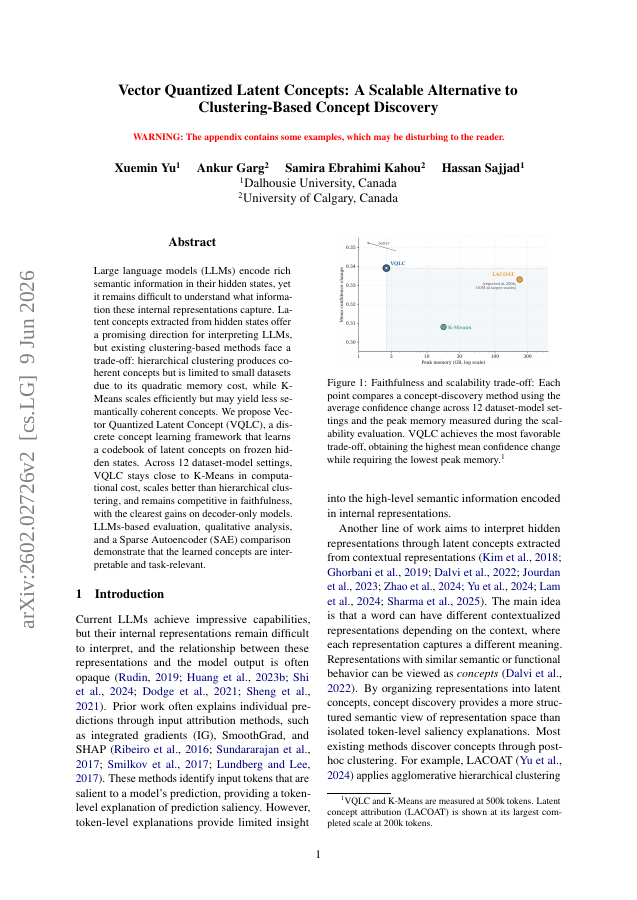
Large language models (LLMs) encode rich semantic information in their hidden states, yet it remains difficult to understand what information these internal representations capture. Latent concepts extracted from hidden states offer a promising direction for interpreting LLMs, but existing clustering-based methods face a trade-off: hierarchical clustering produces coherent concepts but is limited to small datasets due to its quadratic memory cost, while K-Means scales efficiently but may yield less semantically coherent concepts. We propose Vector Quantized Latent Concept (VQLC), a discrete concept learning framework that learns a codebook of latent concepts on frozen hidden states. Across 12 dataset-model settings, VQLC stays close to K-Means in computational cost, scales better than hierarchical clustering, and remains competitive in faithfulness, with the clearest gains on decoder-only models. LLMs-based evaluation, qualitative analysis, and a Sparse Autoencoder (SAE) comparison demonstrate that the learned concepts are interpretable and task-relevant.
Vector Quantized Latent Concepts: A Scalable Alternative to Clustering-Based Concept Discovery
Large language models (LLMs) encode rich semantic information in their hidden states, yet it remains difficult to understand what information these internal representations capture.
- Preview
- Year
- 2026
- Hosting
- Full text hostedCC-BY-4.0
Cite
Notes
Only stored in your browser.
Attribution
- Abstract & full text
- arxiv.org/abs/2602.02726CC-BY-4.0
- TL;DR
- Semantic Scholar