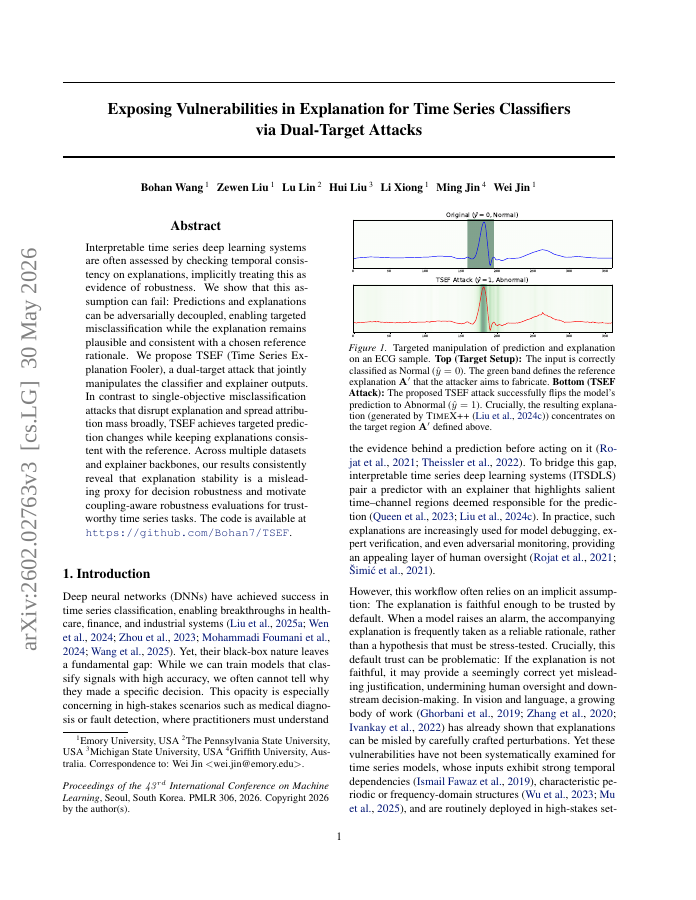
Interpretable time series deep learning systems are often assessed by checking temporal consistency on explanations, implicitly treating this as evidence of robustness. We show that this assumption can fail: Predictions and explanations can be adversarially decoupled, enabling targeted misclassification while the explanation remains plausible and consistent with a chosen reference rationale. We propose TSEF (Time Series Explanation Fooler), a dual-target attack that jointly manipulates the classifier and explainer outputs. In contrast to single-objective misclassification attacks that disrupt explanation and spread attribution mass broadly, TSEF achieves targeted prediction changes while keeping explanations consistent with the reference. Across multiple datasets and explainer backbones, our results consistently reveal that explanation stability is a misleading proxy for decision robustness and motivate coupling-aware robustness evaluations for trustworthy time series tasks.
Exposing Vulnerabilities in Explanation for Time Series Classifiers via Dual-Target Attacks
Interpretable time series deep learning systems are often assessed by checking temporal consistency on explanations, implicitly treating this as evidence of robustness. We show that this assumption can fail: Predictions and explanations can be adversarially decoupled, enabling…
- Preview
- Year
- 2026
- Hosting
- Full text hostedCC-BY-4.0
Cite
Notes
Only stored in your browser.
Attribution
- Abstract & full text
- arxiv.org/abs/2602.02763CC-BY-4.0
- TL;DR
- Semantic Scholar