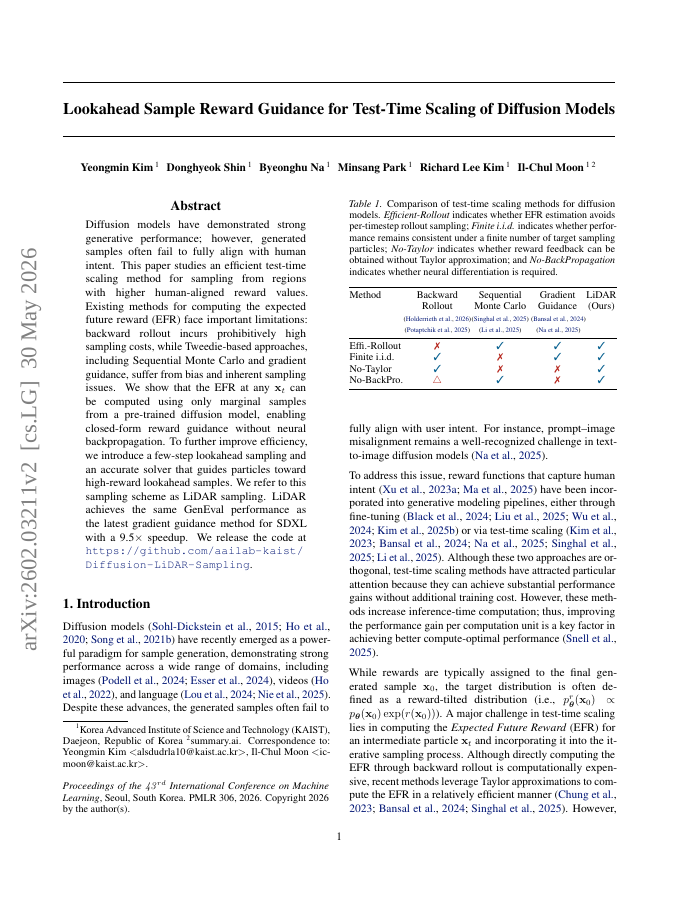
Diffusion models have demonstrated strong generative performance; however, generated samples often fail to fully align with human intent. This paper studies an efficient test-time scaling method for sampling from regions with higher human-aligned reward values. Existing methods for computing the expected future reward (EFR) face important limitations: backward rollout incurs prohibitively high sampling costs, while Tweedie-based approaches, including Sequential Monte Carlo and gradient guidance, suffer from bias and inherent sampling issues. We show that the EFR at any x_t can be computed using only marginal samples from a pre-trained diffusion model, enabling closed-form reward guidance without neural backpropagation. To further improve efficiency, we introduce a few-step lookahead sampling and an accurate solver that guides particles toward high-reward lookahead samples. We refer to this sampling scheme as LiDAR sampling. LiDAR achieves the same GenEval performance as the latest gradient guidance method for SDXL with a 9.5x speedup. We release the code at https://github.com/aailab-kaist/Diffusion-LiDAR-Sampling.
Lookahead Sample Reward Guidance for Test-Time Scaling of Diffusion Models
Diffusion models have demonstrated strong generative performance; however, generated samples often fail to fully align with human intent. This paper studies an efficient test-time scaling method for sampling from regions with higher human-aligned reward values.
- Preview
- Year
- 2026
- Hosting
- Full text hostedCC-BY-4.0
Cite
Notes
Only stored in your browser.
Attribution
- Abstract & full text
- arxiv.org/abs/2602.03211CC-BY-4.0
- TL;DR
- Semantic Scholar