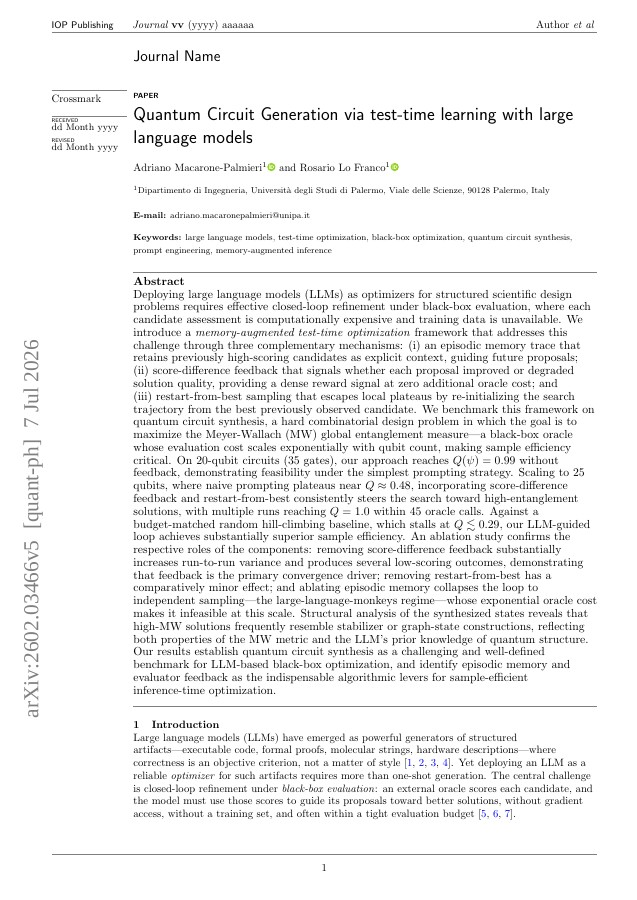
Deploying large language models (LLMs) as optimizers for black-box scientific design problems requires efficient test-time refinement under expensive evaluations and without training data. We propose a memory-augmented test-time optimization framework that combines episodic memory of high-scoring candidates, score-difference feedback, and restart-from-best sampling to improve iterative search. We evaluate the approach on quantum circuit synthesis, where the objective is to maximize the Meyer--Wallach (MW) global entanglement measure under an exponentially expensive black-box oracle. On 20-qubit circuits, the framework achieves Q(ψ)=0.99 without feedback. On the more challenging 25-qubit task, feedback and restart mechanisms enable multiple runs to reach Q(ψ)=1.0 within 45 oracle calls, while a budget-matched random hill-climbing baseline stalls below Q(ψ)\approx0.29. These results demonstrate that memory and evaluator feedback substantially improve the sample efficiency of LLM-based black-box optimization and establish quantum circuit synthesis as a challenging benchmark for test-time optimization.
Quantum Circuit Generation via test-time learning with large language models
Deploying large language models (LLMs) as optimizers for black-box scientific design problems requires efficient test-time refinement under expensive evaluations and without training data.
- Preview
- Year
- 2026
- Hosting
- Full text hostedCC-BY-4.0
Cite
Notes
Only stored in your browser.
Attribution
- Abstract & full text
- arxiv.org/abs/2602.03466CC-BY-4.0
- TL;DR
- Semantic Scholar