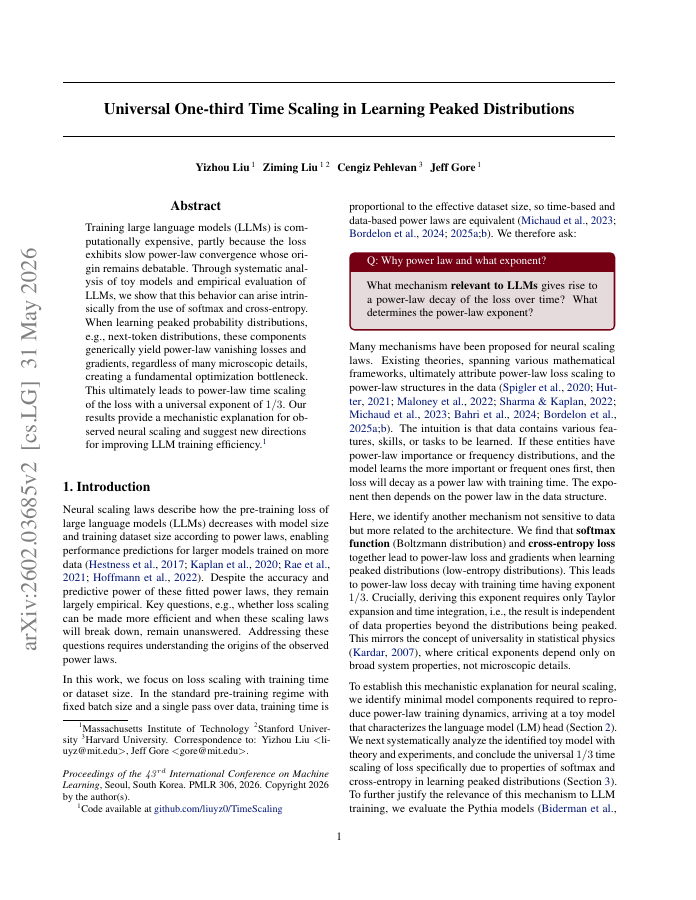
Training large language models (LLMs) is computationally expensive, partly because the loss exhibits slow power-law convergence whose origin remains debatable. Through systematic analysis of toy models and empirical evaluation of LLMs, we show that this behavior can arise intrinsically from the use of softmax and cross-entropy. When learning peaked probability distributions, e.g., next-token distributions, these components generically yield power-law vanishing losses and gradients, regardless of many microscopic details, creating a fundamental optimization bottleneck. This ultimately leads to power-law time scaling of the loss with a universal exponent of $1/3$. Our results provide a mechanistic explanation for observed neural scaling and suggest new directions for improving LLM training efficiency.
Universal One-third Time Scaling in Learning Peaked Distributions
Training large language models (LLMs) is computationally expensive, partly because the loss exhibits slow power-law convergence whose origin remains debatable. Through systematic analysis of toy models and empirical evaluation of LLMs, we show that this behavior can arise…
- Preview
- Year
- 2026
- Hosting
- Full text hostedCC-BY-4.0
Cite
Notes
Only stored in your browser.
Attribution
- Abstract & full text
- arxiv.org/abs/2602.03685CC-BY-4.0
- TL;DR
- Semantic Scholar