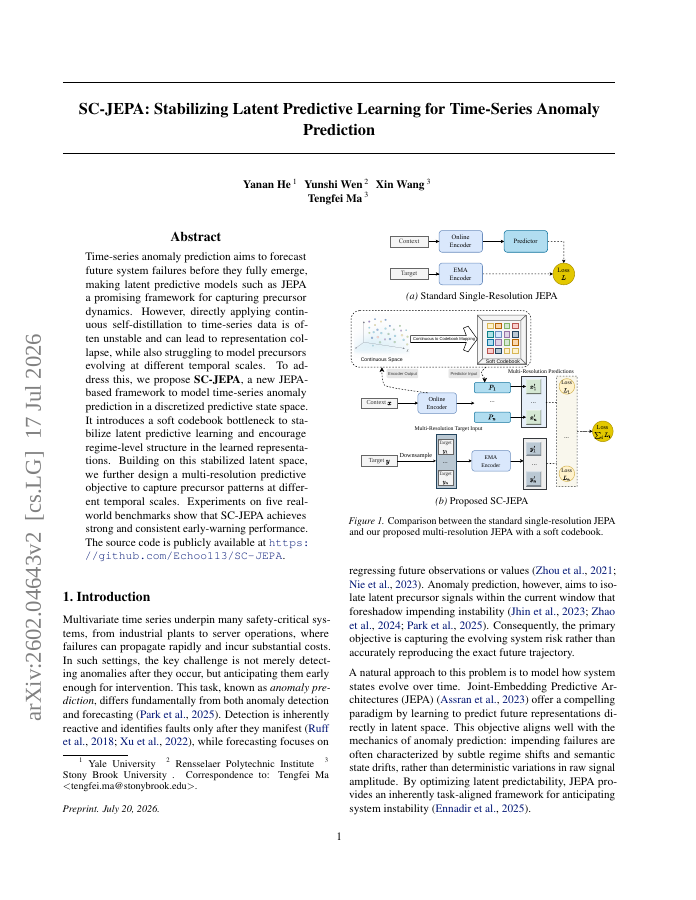
Time-series anomaly prediction aims to forecast future system failures before they fully emerge, making latent predictive models such as JEPA a promising framework for capturing precursor dynamics. However, directly applying continuous self-distillation to time-series data is often unstable and can lead to representation collapse, while also struggling to model precursors evolving at different temporal scales. To address this, we propose SC-JEPA, a new JEPA-based framework to model time-series anomaly prediction in a discretized predictive state space. It introduces a soft codebook bottleneck to stabilize latent predictive learning and encourage regime-level structure in the learned representations. Building on this stabilized latent space, we further design a multi-resolution predictive objective to capture precursor patterns at different temporal scales. Experiments on five real-world benchmarks show that SC-JEPA achieves strong and consistent early-warning performance.
SC-JEPA: Stabilizing Latent Predictive Learning for Time-Series Anomaly Prediction
Time-series anomaly prediction aims to forecast future system failures before they fully emerge, making latent predictive models such as JEPA a promising framework for capturing precursor dynamics.
- Preview
- Year
- 2026
- Hosting
- Abstract onlyARXIV-DEFAULT
Cite
Notes
Only stored in your browser.
Attribution
- Abstract & full text
- arxiv.org/abs/2602.04643ARXIV-DEFAULT
- TL;DR
- Semantic Scholar