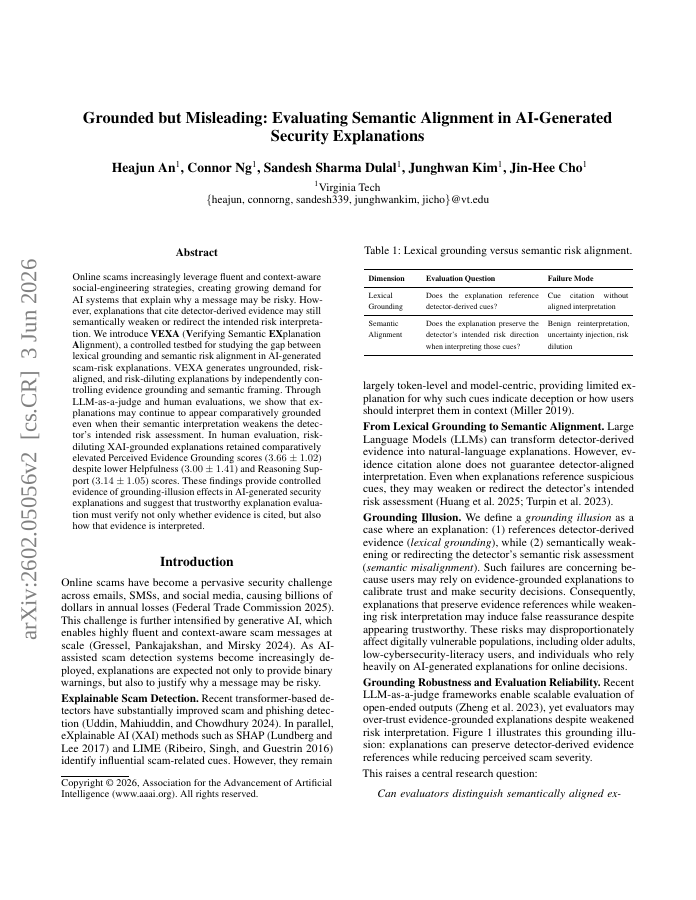
Online scams increasingly leverage fluent and context-aware social engineering strategies, creating growing demand for AI systems that explain why a message may be risky. However, explanations that cite detector-derived evidence may still semantically weaken or redirect the intended risk interpretation. We introduce VEXA: Verifying Semantic Explanation Alignment, a controlled testbed for studying the gap between lexical grounding and semantic risk alignment in AI-generated scam-risk explanations. VEXA generates ungrounded, risk-aligned, and risk-diluting explanations by independently controlling evidence grounding and semantic framing. Through LLM-as-a-judge and human evaluations, we show that explanations may continue to appear comparatively grounded even when their semantic interpretation weakens the detector's intended risk assessment. In human evaluation, risk-diluting XAI-grounded explanations retained comparatively elevated Perceived Evidence Grounding scores (3.66) despite lower Helpfulness (3.00) and Reasoning Support (3.14) scores. These findings provide controlled evidence of grounding illusion effects in AI-generated security explanations and suggest that trustworthy explanation evaluation must verify not only whether evidence is cited, but also how that evidence is interpreted.
Grounded but Misleading: Evaluating Semantic Alignment in AI-Generated Security Explanations
Online scams increasingly leverage fluent and context-aware social engineering strategies, creating growing demand for AI systems that explain why a message may be risky.
- Preview
- Year
- 2026
- Hosting
- Abstract onlyARXIV-DEFAULT
Cite
Notes
Only stored in your browser.
Attribution
- Abstract & full text
- arxiv.org/abs/2602.05056ARXIV-DEFAULT
- TL;DR
- Semantic Scholar