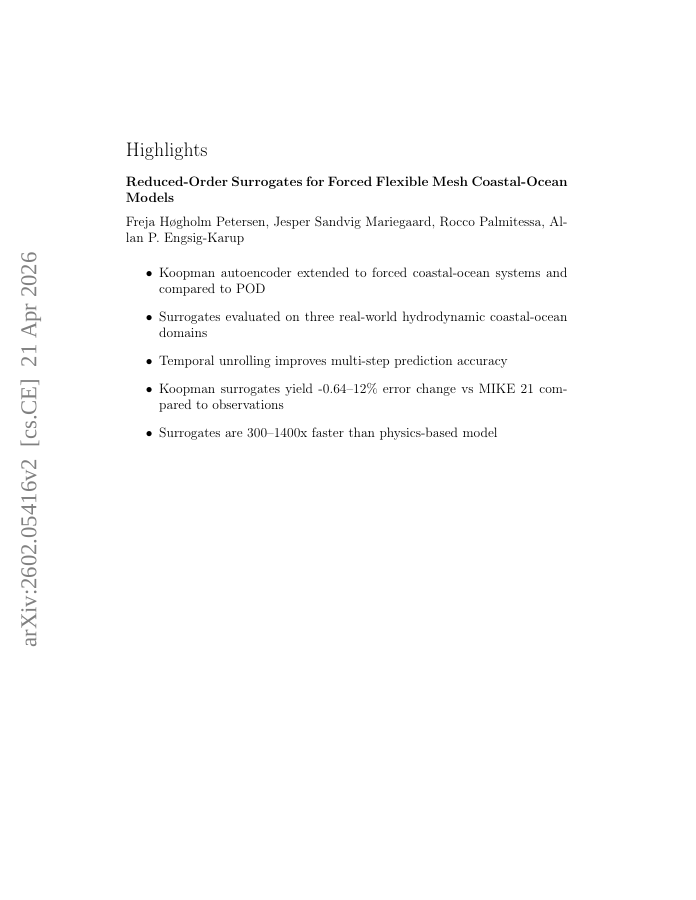
While proper orthogonal decomposition (POD)-based surrogates are widely explored for hydrodynamic applications, the use of Koopman autoencoders for real-world coastal-ocean modelling remains relatively limited. This paper introduces a flexible Koopman autoencoder formulation that incorporates meteorological forcings and boundary conditions, and systematically compares its performance against POD-based surrogates. The Koopman autoencoder employs a learned linear temporal operator in latent space, enabling eigenvalue regularization to promote temporal stability. This strategy is evaluated alongside temporal unrolling techniques for achieving stable and accurate long-term predictions. The models are assessed on three test cases spanning distinct dynamical regimes, with prediction horizons up to one year at 30-minute temporal resolution. Across all cases, the reduced order surrogates with temporal unrolling achieve high accuracy with relative root-mean-squared-errors of 0.0068-0.14 and R^2-values of 0.61-0.995, where prediction errors are largest for current velocities, and smallest for water surface elevations. In two of the three cases, the Koopman Autoencoder have higher accuracy than the POD-based surrogates. Comparing to in-situ observations, the surrogate yields -0.64% to 12% increase in water surface elevation prediction error when compared to prediction errors of the physics-based model. These error levels, corresponding to a few centimeters, are acceptable for many practical applications, while inference speed-ups of 300-1400x enables workflows such as ensemble forecasting and long climate simulations for coastal-ocean modelling.
Reduced-Order Surrogates for Forced Flexible Mesh Coastal-Ocean Models
While proper orthogonal decomposition (POD)-based surrogates are widely explored for hydrodynamic applications, the use of Koopman autoencoders for real-world coastal-ocean modelling remains relatively limited.
- Preview
- Year
- 2026
- Hosting
- Full text hostedCC-BY-4.0
Cite
Notes
Only stored in your browser.
Attribution
- Abstract & full text
- arxiv.org/abs/2602.05416CC-BY-4.0
- TL;DR
- Semantic Scholar