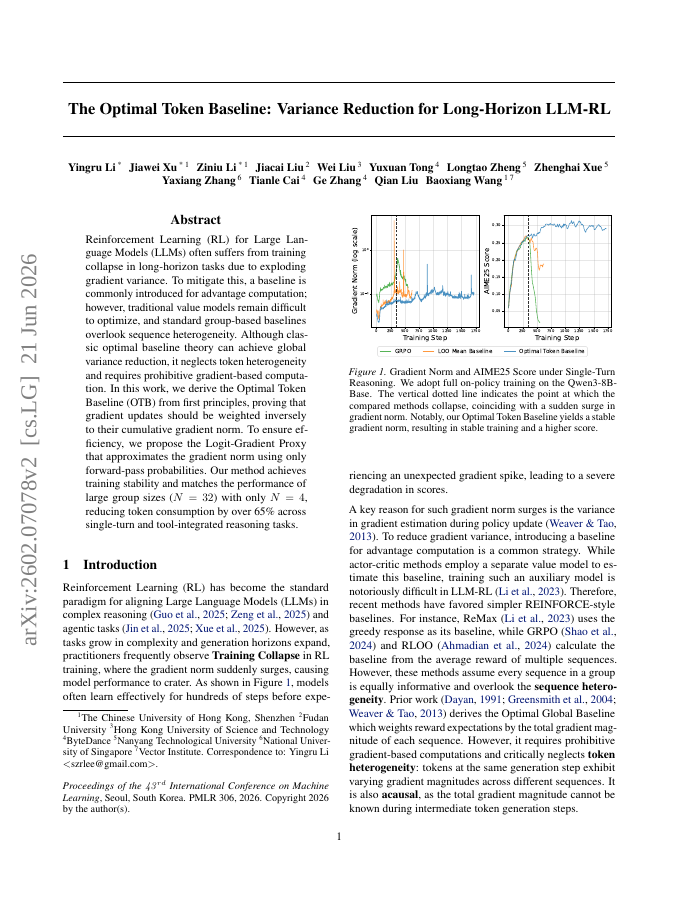
Reinforcement Learning (RL) for Large Language Models (LLMs) often suffers from training collapse in long-horizon tasks due to exploding gradient variance. To mitigate this, a baseline is commonly introduced for advantage computation; however, traditional value models remain difficult to optimize, and standard group-based baselines overlook sequence heterogeneity. Although classic optimal baseline theory can achieve global variance reduction, it neglects token heterogeneity and requires prohibitive gradient-based computation. In this work, we derive the Optimal Token Baseline (OTB) from first principles, proving that gradient updates should be weighted inversely to their cumulative gradient norm. To ensure efficiency, we propose the Logit-Gradient Proxy that approximates the gradient norm using only forward-pass probabilities. Our method achieves training stability and matches the performance of large group sizes (N=32) with only N=4, reducing token consumption by over 65% across single-turn and tool-integrated reasoning tasks.
The Optimal Token Baseline: Variance Reduction for Long-Horizon LLM-RL
Reinforcement Learning (RL) for Large Language Models (LLMs) often suffers from training collapse in long-horizon tasks due to exploding gradient variance. To mitigate this, a baseline is commonly introduced for advantage computation; however, traditional value models remain…
- Preview
- Year
- 2026
- Hosting
- Abstract onlyARXIV-DEFAULT
Cite
Notes
Only stored in your browser.
Attribution
- Abstract & full text
- arxiv.org/abs/2602.07078ARXIV-DEFAULT
- TL;DR
- Semantic Scholar