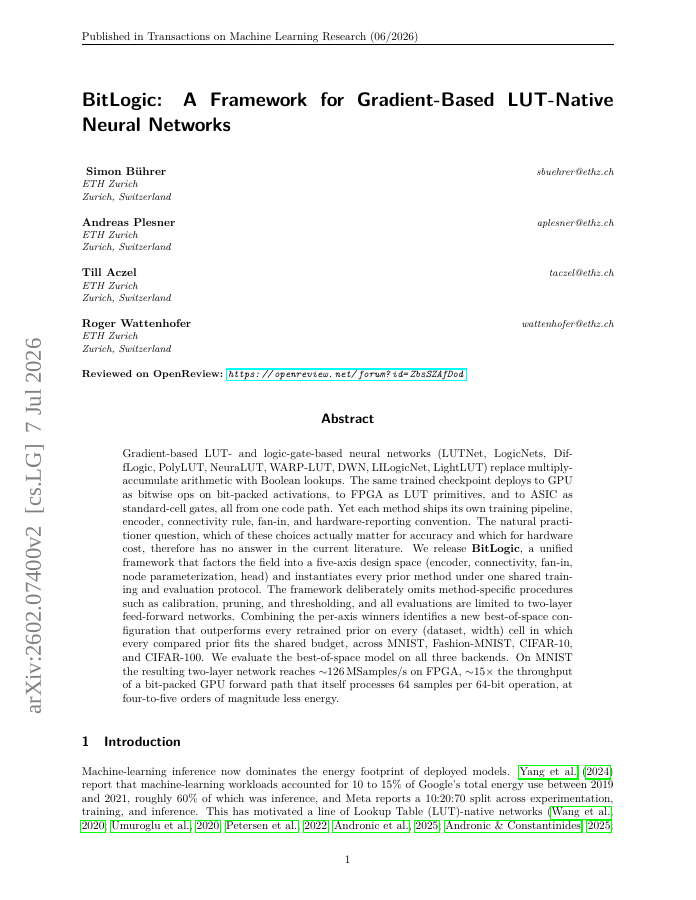
Gradient-based LUT- and logic-gate-based neural networks (LUTNet, LogicNets, DiffLogic, PolyLUT, NeuraLUT, WARP-LUT, DWN, LILogicNet, LightLUT) replace multiply-accumulate arithmetic with Boolean lookups. The same trained checkpoint deploys to GPU as bitwise ops on bit-packed activations, to FPGA as LUT primitives, and to ASIC as standard-cell gates, all from one code path. Yet each method ships its own training pipeline, encoder, connectivity rule, fan-in, and hardware-reporting convention. The natural practitioner question, which of these choices actually matter for accuracy and which for hardware cost, therefore has no answer in the current literature. We release BitLogic, a unified framework that factors the field into a five-axis design space (encoder, connectivity, fan-in, node parameterization, head) and instantiates every prior method under one shared training and evaluation protocol. The framework deliberately omits method-specific procedures such as calibration, pruning, and thresholding, and all evaluations are limited to two-layer feed-forward networks. Combining the per-axis winners identifies a new best-of-space configuration that outperforms every retrained prior on every (dataset, width) cell in which every compared prior fits the shared budget, across MNIST, Fashion-MNIST, CIFAR-10, and CIFAR-100. We evaluate the best-of-space model on all three backends. On MNIST, the resulting two-layer network reaches {\sim}126,MSamples/s on FPGA, {\sim}15\times the throughput of a bit-packed GPU forward path that itself processes 64 samples per 64-bit operation, at four-to-five orders of magnitude less energy.
BitLogic: Training Framework for Gradient-Based FPGA-Native Neural Networks
Gradient-based LUT- and logic-gate-based neural networks (LUTNet, LogicNets, DiffLogic, PolyLUT, NeuraLUT, WARP-LUT, DWN, LILogicNet, LightLUT) replace multiply-accumulate arithmetic with Boolean lookups.
- Preview
- Year
- 2026
- Hosting
- Full text hostedCC-BY-SA-4.0
Cite
Notes
Only stored in your browser.
Attribution
- Abstract & full text
- arxiv.org/abs/2602.07400CC-BY-SA-4.0
- TL;DR
- Semantic Scholar