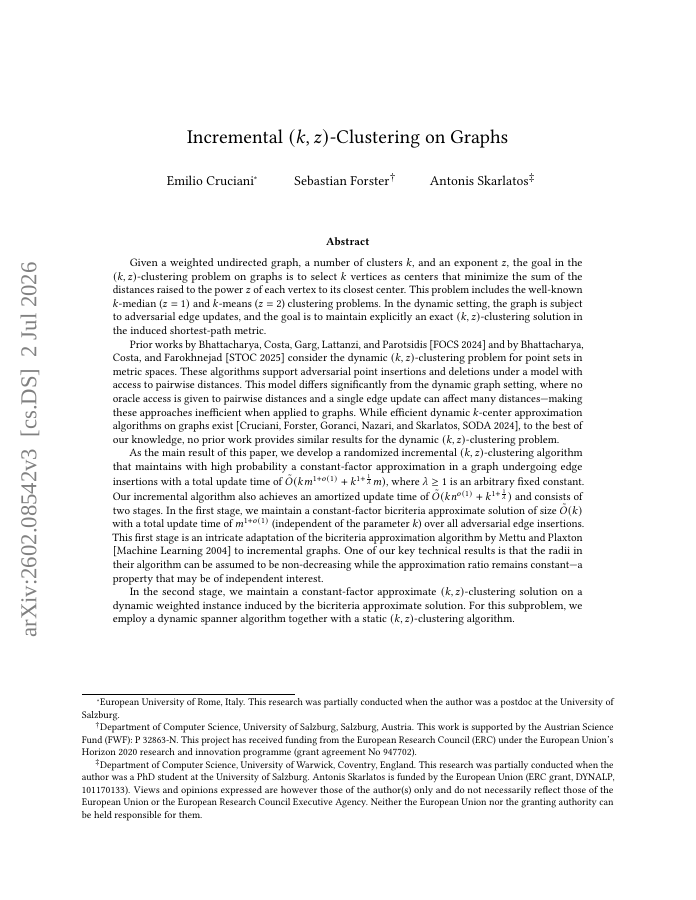
Given a weighted undirected graph, a number of clusters k, and an exponent z, the goal in the (k, z)-clustering problem on graphs is to select k vertices as centers that minimize the sum of the distances raised to the power z of each vertex to its closest center. In the dynamic setting, the graph is subject to adversarial edge updates, and the goal is to maintain explicitly an exact (k, z)-clustering solution in the induced shortest-path metric. While efficient dynamic k-center approximation algorithms on graphs exist [Cruciani et al. SODA 2024], to the best of our knowledge, no prior work provides similar results for the dynamic (k,z)-clustering problem. As the main result of this paper, we develop a randomized incremental (k, z)-clustering algorithm that maintains with high probability a constant-factor approximation in a graph undergoing edge insertions with a total update time of \tilde O(k m^{1+o(1)}+ k^{1+\frac{1}λ} m), where λ\geq 1 is an arbitrary fixed constant. Our incremental algorithm consists of two stages. In the first stage, we maintain a constant-factor bicriteria approximate solution of size \tilde{O}(k) with a total update time of m^{1+o(1)} over all adversarial edge insertions. This first stage is an intricate adaptation of the bicriteria approximation algorithm by Mettu and Plaxton [Machine Learning 2004] to incremental graphs. One of our key technical results is that the radii in their algorithm can be assumed to be non-decreasing while the approximation ratio remains constant, a property that may be of independent interest. In the second stage, we maintain a constant-factor approximate (k,z)-clustering solution on a dynamic weighted instance induced by the bicriteria approximate solution. For this subproblem, we employ a dynamic spanner algorithm together with a static (k,z)-clustering algorithm.
Incremental (k, z)-Clustering on Graphs
Given a weighted undirected graph, a number of clusters $k$, and an exponent $z$, the goal in the $(k, z)$-clustering problem on graphs is to select $k$ vertices as centers that minimize the sum of the distances raised to the power $z$ of each vertex to its closest center.
- Preview
- Year
- 2026
- Hosting
- Full text hostedCC-BY-4.0
Cite
Notes
Only stored in your browser.
Attribution
- Abstract & full text
- arxiv.org/abs/2602.08542CC-BY-4.0
- TL;DR
- Semantic Scholar