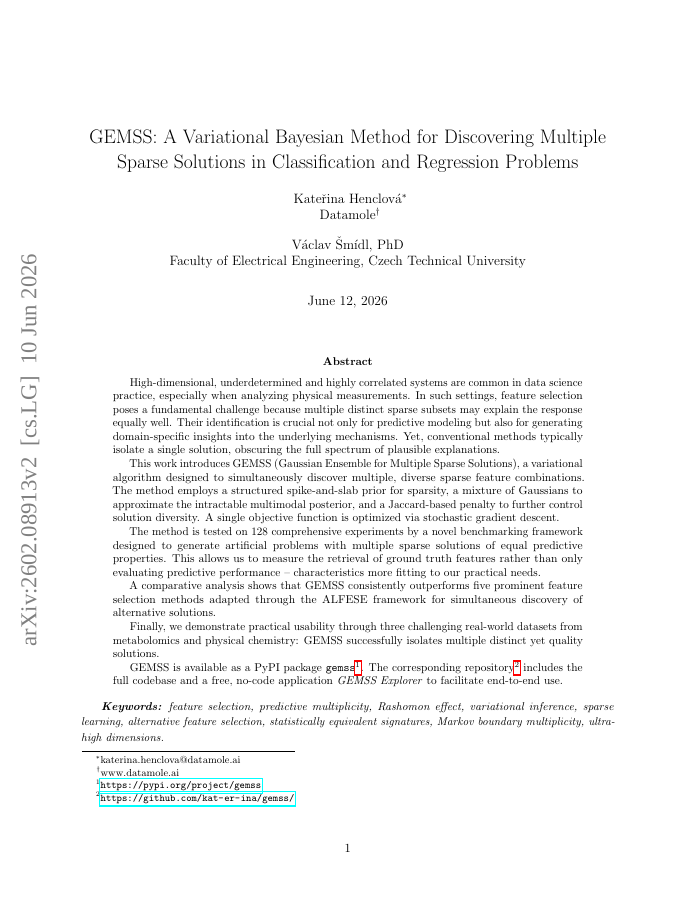
High-dimensional, underdetermined and highly correlated systems are common in data science practice, especially when analyzing physical measurements. In such settings, feature selection poses a fundamental challenge because multiple distinct sparse subsets may explain the response equally well. Their identification is crucial not only for predictive modeling but also for generating domain-specific insights into the underlying mechanisms. Yet, conventional methods typically isolate a single solution, obscuring the full spectrum of plausible explanations. This work introduces GEMSS (Gaussian Ensemble for Multiple Sparse Solutions), a variational algorithm designed to simultaneously discover multiple, diverse sparse feature combinations. The method employs a structured spike-and-slab prior for sparsity, a mixture of Gaussians to approximate the intractable multimodal posterior, and a Jaccard-based penalty to further control solution diversity. A single objective function is optimized via stochastic gradient descent. The method is tested on 128 comprehensive experiments by a novel benchmarking framework designed to generate artificial problems with multiple sparse solutions of equal predictive properties. This allows us to measure the retrieval of ground truth features rather than only evaluating predictive performance -- characteristics more fitting to our practical needs. A comparative analysis shows that GEMSS consistently outperforms five prominent feature selection methods adapted through the ALFESE framework. Finally, we demonstrate practical usability through 3 challenging real-world datasets from metabolomics and physical chemistry: GEMSS successfully isolates multiple distinct yet quality solutions. GEMSS is available as a PyPI package 'gemss'. The corresponding repository github.com/kat-er-ina/gemss/ includes the full codebase and a free, no-code application GEMSS Explorer.
GEMSS: A Variational Bayesian Method for Discovering Multiple Sparse Solutions in Classification and Regression Problems
High-dimensional, underdetermined and highly correlated systems are common in data science practice, especially when analyzing physical measurements. In such settings, feature selection poses a fundamental challenge because multiple distinct sparse subsets may explain the…
- Preview
- Year
- 2026
- Hosting
- Full text hostedCC-BY-4.0
Cite
Notes
Only stored in your browser.
Attribution
- Abstract & full text
- arxiv.org/abs/2602.08913CC-BY-4.0
- TL;DR
- Semantic Scholar