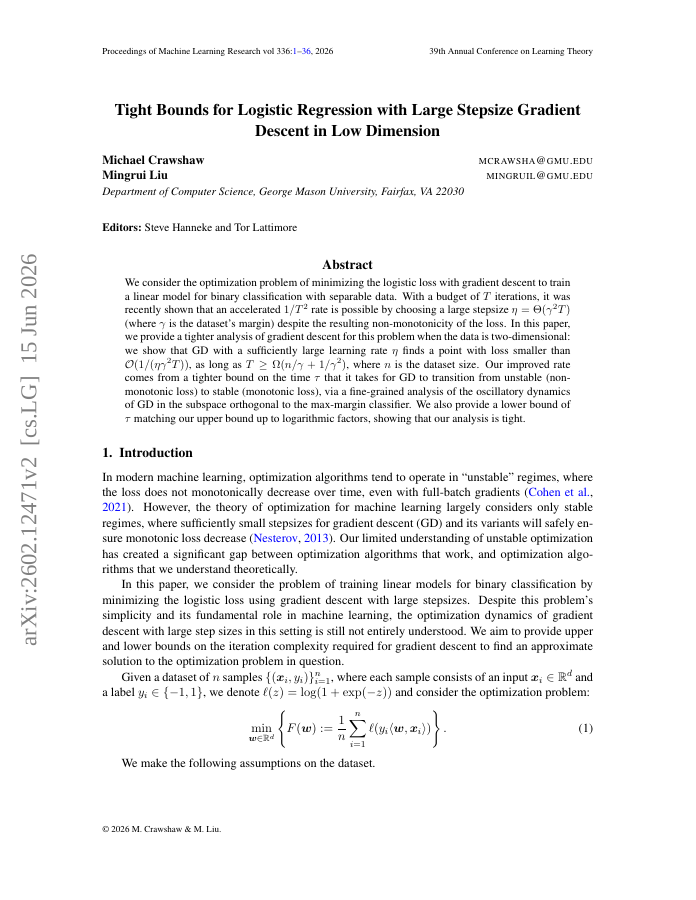
We consider the optimization problem of minimizing the logistic loss with gradient descent to train a linear model for binary classification with separable data. With a budget of T iterations, it was recently shown that an accelerated 1/T^2 rate is possible by choosing a large stepsize η= Θ(γ^2 T) (where γ is the dataset's margin) despite the resulting non-monotonicity of the loss. In this paper, we provide a tighter analysis of gradient descent for this problem when the data is two-dimensional: we show that GD with a sufficiently large learning rate η finds a point with loss smaller than O(1/(ηγ^2 T)), as long as T \geq Ω(n/γ+ 1/γ^2), where n is the dataset size. Our improved rate comes from a tighter bound on the time τ that it takes for GD to transition from unstable (non-monotonic loss) to stable (monotonic loss), via a fine-grained analysis of the oscillatory dynamics of GD in the subspace orthogonal to the max-margin classifier. We also provide a lower bound of τ matching our upper bound up to logarithmic factors, showing that our analysis is tight.
Tight Bounds for Logistic Regression with Large Stepsize Gradient Descent in Low Dimension
We consider the optimization problem of minimizing the logistic loss with gradient descent to train a linear model for binary classification with separable data. With a budget of $T$ iterations, it was recently shown that an accelerated $1/T^2$ rate is possible by choosing a…
- Preview
- Year
- 2026
- Hosting
- Abstract onlyARXIV-DEFAULT
Cite
Notes
Only stored in your browser.
Attribution
- Abstract & full text
- arxiv.org/abs/2602.12471ARXIV-DEFAULT
- TL;DR
- Semantic Scholar