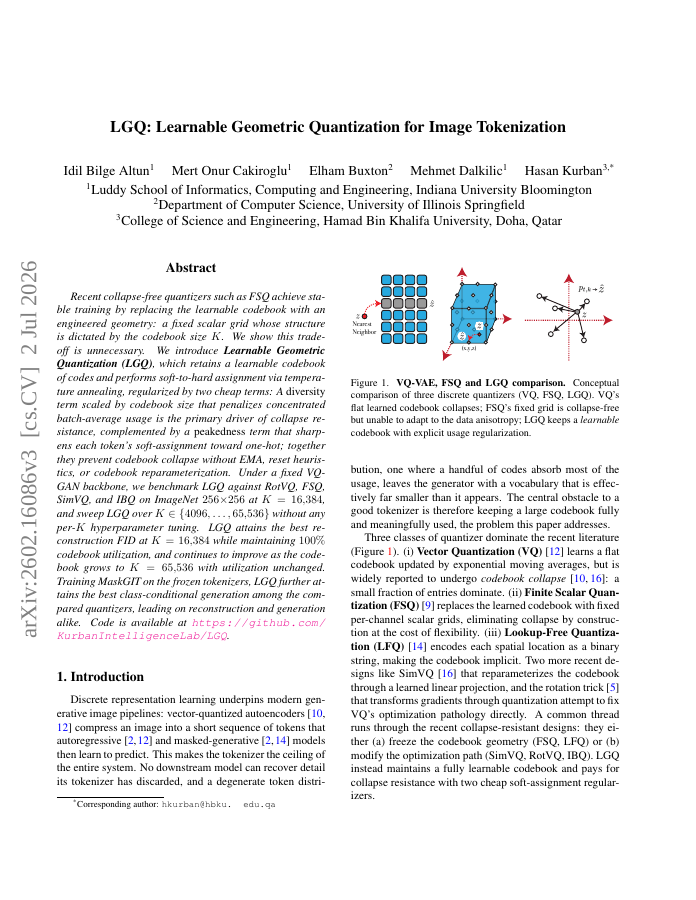
Recent collapse-free quantizers such as FSQ achieve stable training by replacing the learnable codebook with an engineered geometry: a fixed scalar grid whose structure is dictated by the codebook size K. We show this trade-off is unnecessary. We introduce Learnable Geometric Quantization (LGQ), which retains a learnable codebook of codes and performs soft-to-hard assignment via temperature annealing, regularized by two cheap terms: A diversity term scaled by codebook size that penalizes concentrated batch-average usage is the primary driver of collapse resistance, complemented by a peakedness term that sharpens each token's soft-assignment toward one-hot; together they prevent codebook collapse without EMA, reset heuristics, or codebook reparameterization. Under a fixed VQ-GAN backbone, we benchmark LGQ against RotVQ, FSQ, SimVQ, and IBQ on ImageNet 256x256 at K=16,384 and sweep LGQ over K={4096,..,65,536} without any per-K hyperparameter tuning. LGQ attains the best reconstruction FID at K = 16,384 while maintaining 100% codebook utilization, and continues to improve as the codebook grows to K = 65,536 with utilization unchanged. Training MaskGIT on the frozen tokenizers, LGQ further attains the best class-conditional generation among the compared quantizers, leading on reconstruction and generation alike. Code is available at https://github.com/KurbanIntelligenceLab/LGQ.
LGQ: Learnable Geometric Quantization for Image Tokenization
Recent collapse-free quantizers such as FSQ achieve stable training by replacing the learnable codebook with an engineered geometry: a fixed scalar grid whose structure is dictated by the codebook size K. We show this trade-off is unnecessary.
- Preview
- Year
- 2026
- Hosting
- Full text hostedCC-BY-4.0
Cite
Notes
Only stored in your browser.
Attribution
- Abstract & full text
- arxiv.org/abs/2602.16086CC-BY-4.0
- TL;DR
- Semantic Scholar