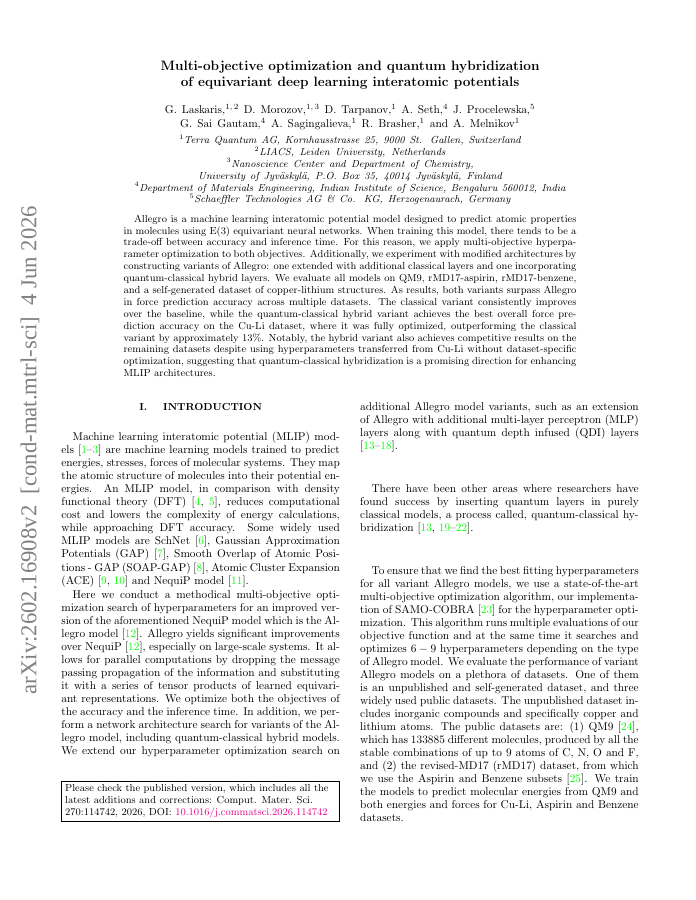
Allegro is a machine learning interatomic potential model designed to predict atomic properties in molecules using E(3) equivariant neural networks. When training this model, there tends to be a trade-off between accuracy and inference time. For this reason, we apply multi-objective hyperparameter optimization to both objectives. Additionally, we experiment with modified architectures by constructing variants of Allegro: one extended with additional classical layers and one incorporating quantum-classical hybrid layers. We evaluate all models on QM9, rMD17-aspirin, rMD17-benzene, and a self-generated dataset of copper-lithium structures. As results, both variants surpass Allegro in force prediction accuracy across multiple datasets. The classical variant consistently improves over the baseline, while the quantum-classical hybrid variant achieves the best overall force prediction accuracy on the Cu-Li dataset, where it was fully optimized, outperforming the classical variant by approximately 13%. Notably, the hybrid variant also achieves competitive results on the remaining datasets despite using hyperparameters transferred from Cu-Li without dataset-specific optimization, suggesting that quantum-classical hybridization is a promising direction for enhancing MLIP architectures.
Multi-objective optimization and quantum hybridization of equivariant deep learning interatomic potentials
Allegro is a machine learning interatomic potential model designed to predict atomic properties in molecules using E(3) equivariant neural networks. When training this model, there tends to be a trade-off between accuracy and inference time.
- Preview
- Year
- 2026
- Hosting
- Full text hostedCC-BY-4.0
Cite
Notes
Only stored in your browser.
Attribution
- Abstract & full text
- arxiv.org/abs/2602.16908CC-BY-4.0
- TL;DR
- Semantic Scholar