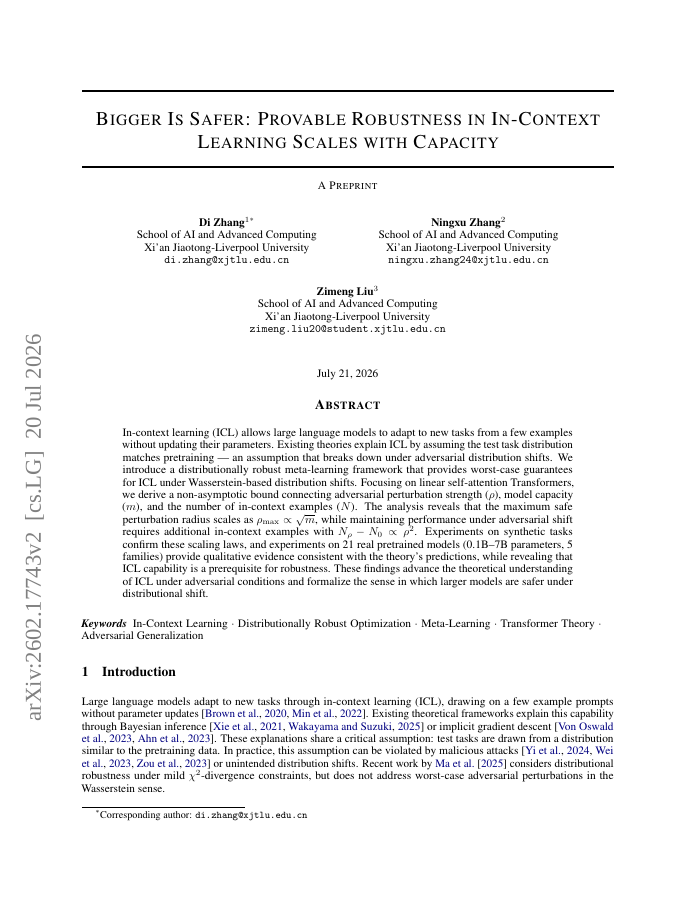
In-context learning (ICL) allows large language models to adapt to new tasks from a few examples without updating their parameters. Existing theories explain ICL by assuming the test task distribution matches pretraining -- an assumption that breaks down under adversarial distribution shifts. We introduce a distributionally robust meta-learning framework that provides worst-case guarantees for ICL under Wasserstein-based distribution shifts. Focusing on linear self-attention Transformers, we derive a non-asymptotic bound connecting adversarial perturbation strength (ρ), model capacity (m), and the number of in-context examples (N). The analysis reveals that the maximum safe perturbation radius scales as ρ_{\max} \propto \sqrt{m}, while maintaining performance under adversarial shift requires additional in-context examples with N_ρ- N_0 \propto ρ^2. Experiments on synthetic tasks confirm these scaling laws, and experiments on 21 real pretrained models (0.1B--7B parameters, 5 families) provide qualitative evidence consistent with the theory's predictions, while revealing that ICL capability is a prerequisite for robustness. These findings advance the theoretical understanding of ICL under adversarial conditions and formalize the sense in which larger models are safer under distributional shift.
Bigger Is Safer: Provable Robustness in In-Context Learning Scales with Capacity
In-context learning (ICL) allows large language models to adapt to new tasks from a few examples without updating their parameters. Existing theories explain ICL by assuming the test task distribution matches pretraining -- an assumption that breaks down under adversarial…
- Preview
- Year
- 2026
- Hosting
- Abstract onlyARXIV-DEFAULT
Cite
Notes
Only stored in your browser.
Attribution
- Abstract & full text
- arxiv.org/abs/2602.17743ARXIV-DEFAULT
- TL;DR
- Semantic Scholar