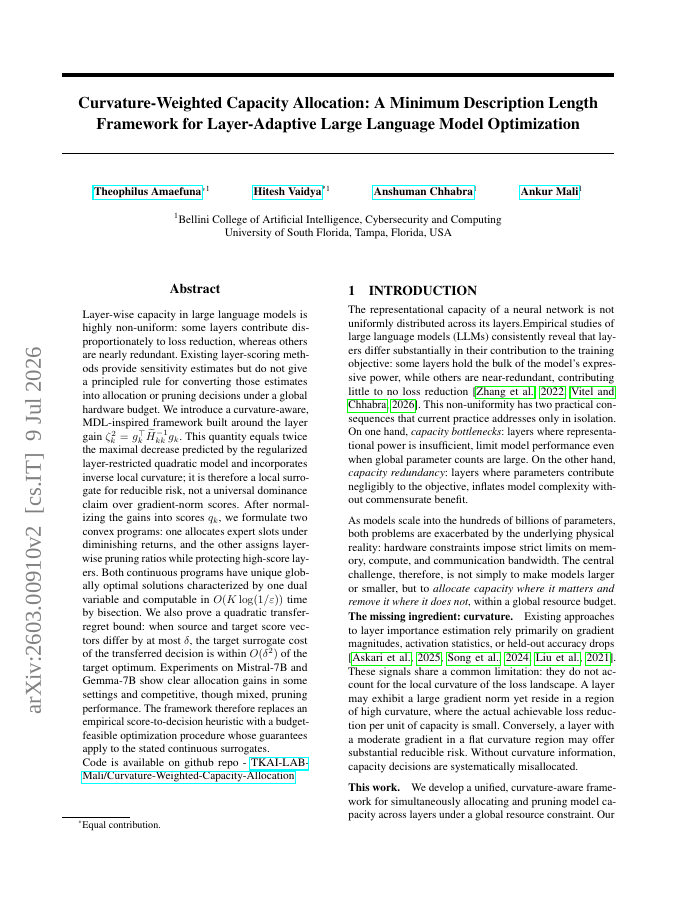
Layer-wise capacity in large language models is highly non-uniform: some layers contribute disproportionately to loss reduction, whereas others are nearly redundant. Existing layer-scoring methods provide sensitivity estimates but do not give a principled rule for converting those estimates into allocation or pruning decisions under a global hardware budget. We introduce a curvature-aware, MDL-inspired framework built around the layer gain ζ_k^2=g_k^\top\widetilde H_{kk}^{-1}g_k. This quantity equals twice the maximal decrease predicted by the regularized layer-restricted quadratic model and incorporates inverse local curvature; it is therefore a local surrogate for reducible risk, not a universal dominance claim over gradient-norm scores. After normalizing the gains into scores q_k, we formulate two convex programs: one allocates expert slots under diminishing returns, and the other assigns layer-wise pruning ratios while protecting high-score layers. Both continuous programs have unique globally optimal solutions characterized by one dual variable and computable in O(K\log(1/\varepsilon)) time by bisection. We also prove a quadratic transfer-regret bound: when source and target score vectors differ by at most δ, the target surrogate cost of the transferred decision is within O(δ^2) of the target optimum. Experiments on Mistral-7B and Gemma-7B show clear allocation gains in some settings and competitive, though mixed, pruning performance. The framework therefore replaces an empirical score-to-decision heuristic with a budget-feasible optimization procedure whose guarantees apply to the stated continuous surrogates. Code is available on github repo - TKAI-LAB-Mali/Curvature-Weighted-Capacity-Allocation
Curvature-Weighted Capacity Allocation: A Minimum Description Length Framework for Layer-Adaptive Large Language Model Optimization
Layer-wise capacity in large language models is highly non-uniform: some layers contribute disproportionately to loss reduction, whereas others are nearly redundant. Existing layer-scoring methods provide sensitivity estimates but do not give a principled rule for converting…
- Preview
- Year
- 2026
- Hosting
- Full text hostedCC-BY-4.0
Cite
Notes
Only stored in your browser.
Attribution
- Abstract & full text
- arxiv.org/abs/2603.00910CC-BY-4.0
- TL;DR
- Semantic Scholar