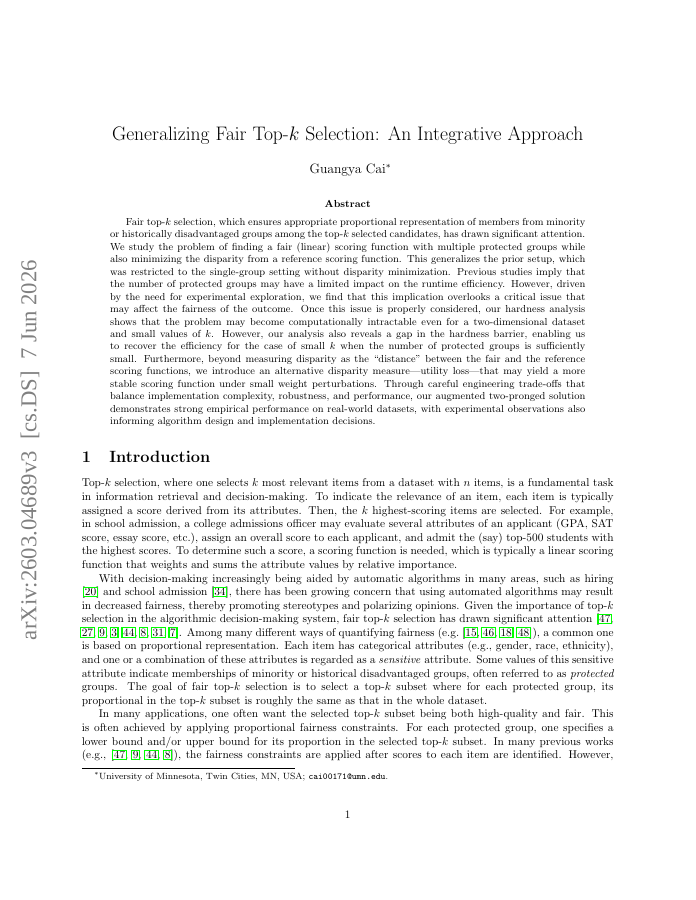
Fair top-k selection, which ensures appropriate proportional representation of members from minority or historically disadvantaged groups among the top-k selected candidates, has drawn significant attention. We study the problem of finding a fair (linear) scoring function with multiple protected groups while also minimizing the disparity from a reference scoring function. This generalizes the prior setup, which was restricted to the single-group setting without disparity minimization. Previous studies imply that the number of protected groups may have a limited impact on the runtime efficiency. However, driven by the need for experimental exploration, we find that this implication overlooks a critical issue that may affect the fairness of the outcome. Once this issue is properly considered, our hardness analysis shows that the problem may become computationally intractable even for a two-dimensional dataset and small values of k. However, our analysis also reveals a gap in the hardness barrier, enabling us to recover the efficiency for the case of small k when the number of protected groups is sufficiently small. Furthermore, beyond measuring disparity as the "distance" between the fair and the reference scoring functions, we introduce an alternative disparity measure\unicode{x2014}utility loss\unicode{x2014}that may yield a more stable scoring function under small weight perturbations. Through careful engineering trade-offs that balance implementation complexity, robustness, and performance, our augmented two-pronged solution demonstrates strong empirical performance on real-world datasets, with experimental observations also informing algorithm design and implementation decisions.
Generalizing Fair Top-$k$ Selection: An Integrative Approach
Fair top-$k$ selection, which ensures appropriate proportional representation of members from minority or historically disadvantaged groups among the top-$k$ selected candidates, has drawn significant attention.
- Preview
- Year
- 2026
- Hosting
- Full text hostedCC-BY-4.0
Cite
Notes
Only stored in your browser.
Attribution
- Abstract & full text
- arxiv.org/abs/2603.04689CC-BY-4.0
- TL;DR
- Semantic Scholar