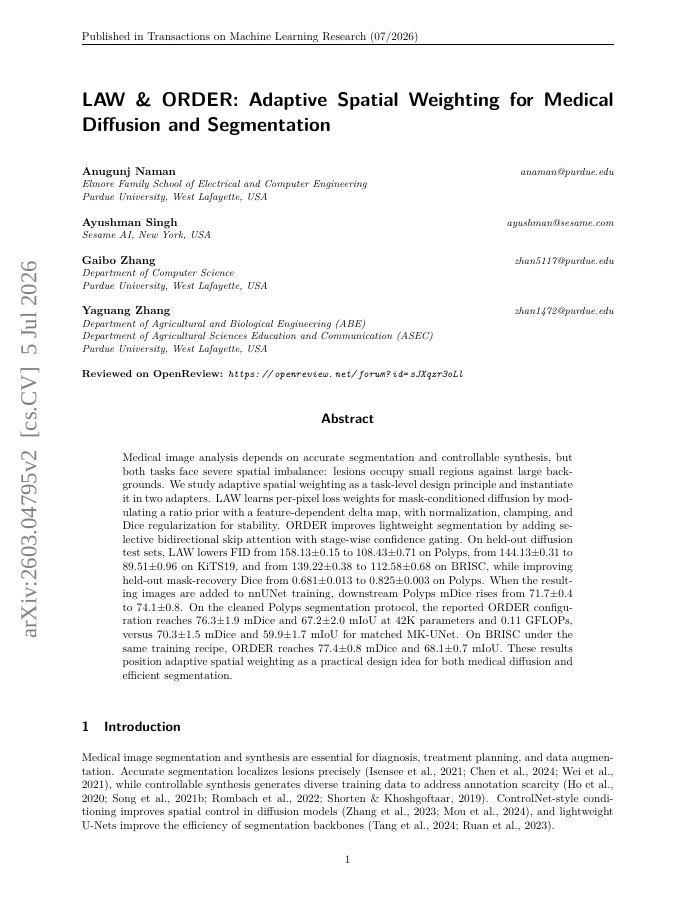
Medical image analysis depends on accurate segmentation and controllable synthesis, but both tasks face severe spatial imbalance: lesions occupy small regions against large backgrounds. We study adaptive spatial weighting as a task-level design principle and instantiate it in two adapters. LAW learns per-pixel loss weights for mask-conditioned diffusion by modulating a ratio prior with a feature-dependent delta map, with normalization, clamping, and Dice regularization for stability. ORDER improves lightweight segmentation by adding selective bidirectional skip attention with stage-wise confidence gating. On held-out diffusion test sets, LAW lowers FID from 158.13\pm0.15 to 108.43\pm0.71 on Polyps, from 144.13\pm0.31 to 89.51\pm0.96 on KiTS19, and from 139.22\pm0.38 to 112.58\pm0.68 on BRISC, while improving held-out mask-recovery Dice from 0.681\pm0.013 to 0.825\pm0.003 on Polyps. When the resulting images are added to nnUNet training, downstream Polyps mDice rises from 71.7\pm0.4 to 74.1\pm0.8. On the cleaned Polyps segmentation protocol, the reported ORDER configuration reaches 76.3\pm1.9 mDice and 67.2\pm2.0 mIoU at 42K parameters and 0.11 GFLOPs, versus 70.3\pm1.5 mDice and 59.9\pm1.7 mIoU for matched MK-UNet. On BRISC under the same training recipe, ORDER reaches 77.4\pm0.8 mDice and 68.1\pm0.7 mIoU. These results position adaptive spatial weighting as a practical design idea for both medical diffusion and efficient segmentation.
LAW & ORDER: Adaptive Spatial Weighting for Medical Diffusion and Segmentation
Medical image analysis depends on accurate segmentation and controllable synthesis, but both tasks face severe spatial imbalance: lesions occupy small regions against large backgrounds.
- Preview
- Year
- 2026
- Hosting
- Full text hostedCC-BY-4.0
Cite
Notes
Only stored in your browser.
Attribution
- Abstract & full text
- arxiv.org/abs/2603.04795CC-BY-4.0
- TL;DR
- Semantic Scholar