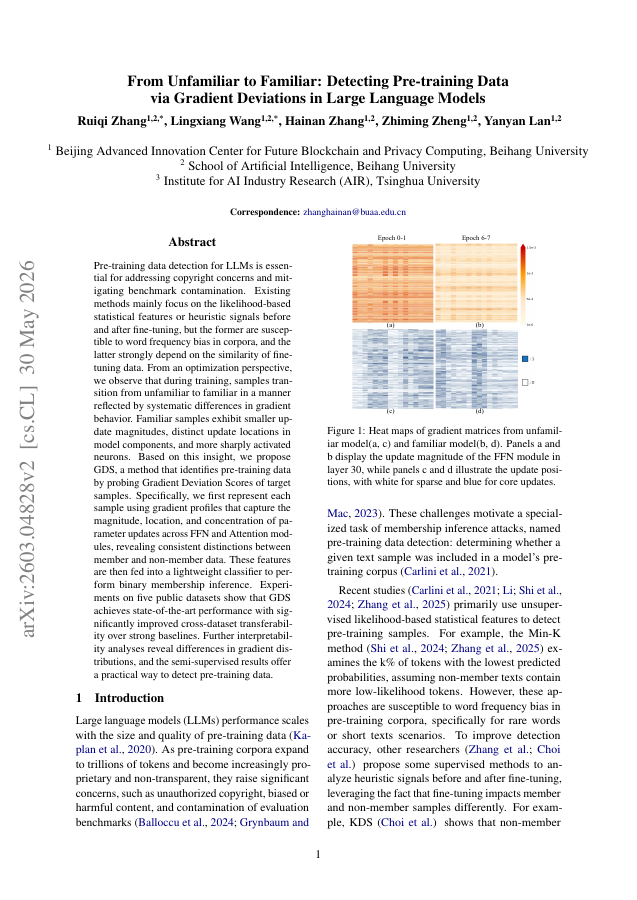
Pre-training data detection for LLMs is essential for addressing copyright concerns and mitigating benchmark contamination. Existing methods mainly focus on the likelihood-based statistical features or heuristic signals before and after fine-tuning, but the former are susceptible to word frequency bias in corpora, and the latter strongly depend on the similarity of fine-tuning data. From an optimization perspective, we observe that during training, samples transition from unfamiliar to familiar in a manner reflected by systematic differences in gradient behavior. Familiar samples exhibit smaller update magnitudes, distinct update locations in model components, and more sharply activated neurons. Based on this insight, we propose GDS, a method that identifies pre-training data by probing Gradient Deviation Scores of target samples. Specifically, we first represent each sample using gradient profiles that capture the magnitude, location, and concentration of parameter updates across FFN and Attention modules, revealing consistent distinctions between member and non-member data. These features are then fed into a lightweight classifier to perform binary membership inference. Experiments on five public datasets show that GDS achieves state-of-the-art performance with significantly improved cross-dataset transferability over strong baselines. Further interpretability analyses reveal differences in gradient distributions, and the semi-supervised results offer a practical way to detect pre-training data.
From Unfamiliar to Familiar: Detecting Pre-training Data via Gradient Deviations in Large Language Models
Pre-training data detection for LLMs is essential for addressing copyright concerns and mitigating benchmark contamination. Existing methods mainly focus on the likelihood-based statistical features or heuristic signals before and after fine-tuning, but the former are…
- Preview
- Year
- 2026
- Hosting
- Abstract onlyARXIV-DEFAULT
Cite
Notes
Only stored in your browser.
Attribution
- Abstract & full text
- arxiv.org/abs/2603.04828ARXIV-DEFAULT
- TL;DR
- Semantic Scholar