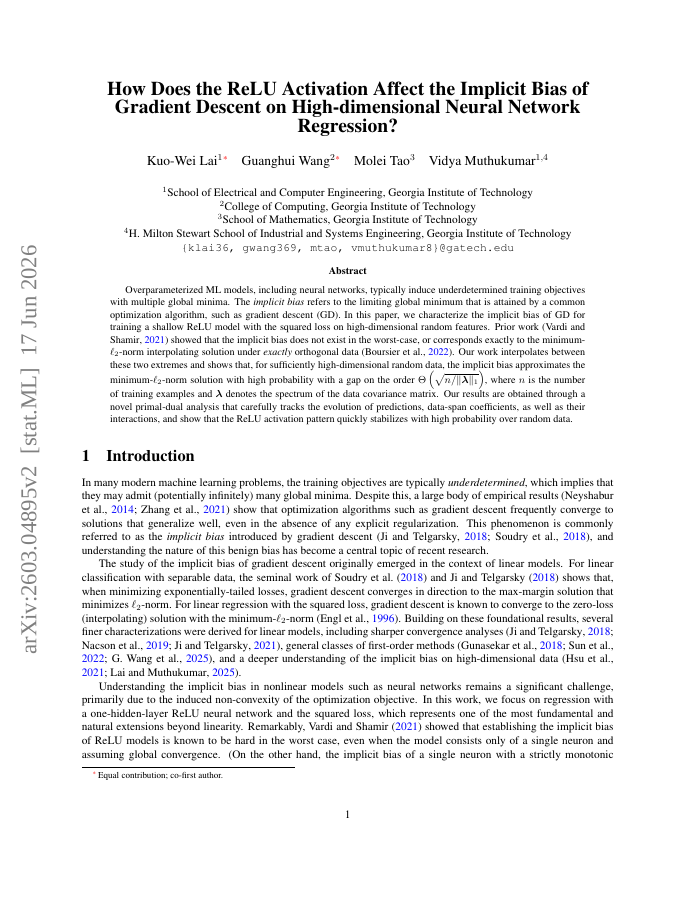
Overparameterized ML models, including neural networks, typically induce underdetermined training objectives with multiple global minima. The implicit bias refers to the limiting global minimum that is attained by a common optimization algorithm, such as gradient descent (GD). In this paper, we characterize the implicit bias of GD for training a shallow ReLU model with the squared loss on high-dimensional random features. Prior work (Vardi and Shamir, 2021) showed that the implicit bias does not exist in the worst-case, or corresponds exactly to the minimum-\ell_2-norm interpolating solution under exactly orthogonal data (Boursier et al., 2022). Our work interpolates between these two extremes and shows that, for sufficiently high-dimensional random data, the implicit bias approximates the minimum-\ell_2-norm solution with high probability with a gap on the order Θ(\sqrt{n/||λ||_1}), where n is the number of training examples and λ denotes the spectrum of the data covariance matrix. Our results are obtained through a novel primal-dual analysis that carefully tracks the evolution of predictions, data-span coefficients, as well as their interactions, and show that the ReLU activation pattern quickly stabilizes with high probability over random data.
How Does the ReLU Activation Affect the Implicit Bias of Gradient Descent on High-dimensional Neural Network Regression?
Overparameterized ML models, including neural networks, typically induce underdetermined training objectives with multiple global minima. The implicit bias refers to the limiting global minimum that is attained by a common optimization algorithm, such as gradient descent (GD).
- Preview
- Year
- 2026
- Hosting
- Abstract onlyARXIV-DEFAULT
Cite
Notes
Only stored in your browser.
Attribution
- Abstract & full text
- arxiv.org/abs/2603.04895ARXIV-DEFAULT
- TL;DR
- Semantic Scholar