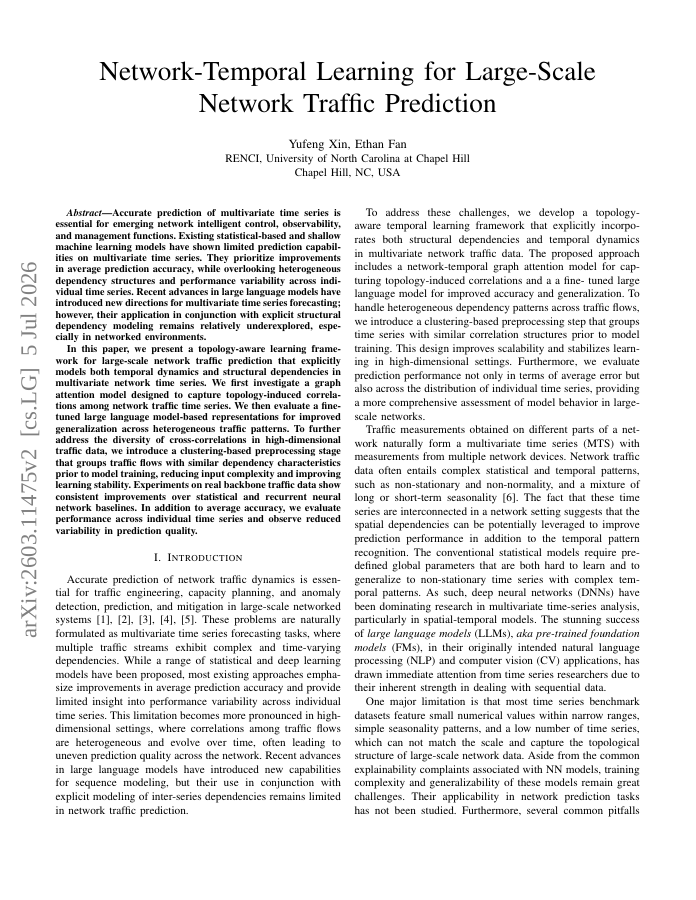
Accurate prediction of multivariate time series is essential for emerging network intelligent control, observability, and management functions. Existing statistical-based and shallow machine learning models have shown limited prediction capabilities on multivariate time series. They prioritize improvements in average prediction accuracy, while overlooking heterogeneous dependency structures and performance variability across individual time series. Recent advances in large language models have introduced new directions for multivariate time series forecasting; however, their application in conjunction with explicit structural dependency modeling remains relatively underexplored, especially in networked environments. In this paper, we present a topology-aware learning framework for large-scale network traffic prediction that explicitly models both temporal dynamics and structural dependencies in multivariate network time series. We first investigate a graph attention model designed to capture topology-induced correlations among network traffic time series. We then evaluate a fine-tuned large language model-based representations for improved generalization across heterogeneous traffic patterns. To further address the diversity of cross-correlations in high-dimensional traffic data, we introduce a clustering-based preprocessing stage that groups traffic flows with similar dependency characteristics prior to model training, reducing input complexity and improving learning stability. Experiments on real backbone traffic data show consistent improvements over statistical and recurrent neural network baselines. In addition to average accuracy, we evaluate performance across individual time series and observe reduced variability in prediction quality.
Deep Learning Network-Temporal Models For Traffic Prediction
Accurate prediction of multivariate time series is essential for emerging network intelligent control, observability, and management functions. Existing statistical-based and shallow machine learning models have shown limited prediction capabilities on multivariate time series.
- Preview
- Year
- 2026
- Hosting
- Abstract onlyARXIV-DEFAULT
Cite
Notes
Only stored in your browser.
Attribution
- Abstract & full text
- arxiv.org/abs/2603.11475ARXIV-DEFAULT
- TL;DR
- Semantic Scholar